<?xml version="1.0" encoding="UTF-8"?>
<rss version="2.0" xmlns:atom="http://www.w3.org/2005/Atom" xml:lang="">
  <channel>
    <title>Brandon Wu by {"name" => "Brandon Wu", "url" => "https://bsky.app/profile/thebrandonwu.bsky.social"}</title>
    <link>https://brandonwu.co</link>
    <copyright>All rights reserved.</copyright>
    <description></description>
    <atom:link href="https://brandonwu.co/feed.xml" rel="self" type="application/rss+xml" />
      <item>
          <title>Build with Local LLM AI Models - Setting Up</title>
          <description><![CDATA[<p>I have been prototyping a number of LLM-powered AI digital products in the past couple of weeks to further understand how to work with and integrate AI models into my own projects and ideas, including running AI models locally, using AI to organise and make connections between my personal notes, creating a desktop app that reads my emails and draft replies in batch, AI as a dungeon master in a rogue-lite game, and using AI to continuously create new landing pages for A/B testing for my GMAT book. I’ll write about each in separate blog posts. But first, let’s get some AI running on my device that I can use to test my projects.</p>

<h2 id="running-llm-models-locally">Running LLM Models Locally</h2>
<p>I want to try running LLM models on my local machine. I have a Mac Studio (Apple M2 Max, 32GB RAM). It’s not the most powerful machine you can build to run AI models, but I wanted to know how capable a typical computer you might find on your desk can be. I have found these local models to be sufficiently capable in most instances for the typical writing related tasks, idea generation, and analysis.</p>

<h3 id="setting-up">Setting Up</h3>
<p>The easiest way I found is to simply use <a href="https://ollama.com/">Ollama</a>, which is a desktop platform that allows you to run and interact with AI models locally on your device.</p>

<!--more-->

<p>Once installed, you run commands through its terminal interface to install models and manage them. (Use Terminal app on the Mac, and Command Prompt or PowerShell on Windows). You can simply type in “ollama run [model name]” to run the model. Here’s <a href="https://github.com/ollama/ollama?tab=readme-ov-file#cli-reference">the list of commands</a>.</p>

<p>You can find the list of models available on their <a href="https://ollama.com/search">Models</a> page, which also has commands you can copy and paste into the terminal to run them.</p>

<p><img src="/uploads/2024-12-11-ollama-llama3.2-page.png" alt="" /></p>

<p>After experimenting with a few different models with different parameters/sizes, I am now running</p>

<ul>
  <li><a href="https://ollama.com/library/llama3.2">llama3.2:latest (3b)</a> for general purpose use</li>
  <li><a href="https://ollama.com/hhao/qwen2.5-coder-tools:14b">hhao/qwen2.5-coder-tools:14b</a> for coding agents. (and experimenting with the larger <a href="https://ollama.com/hhao/qwen2.5-coder-tools:14b">32b model</a>)</li>
</ul>

<p>Larger models I’ve tried have been too slow to be very useful. For example, I got a Llama3.3 model (<a href="https://ollama.com/library/llama3.3:70b-instruct-q2_K">70b-instruct-q2_K</a>) to work  on my device but it was painfully slow. Note I have not done any optimisations with them so you might be able to find larger models that work on a computer with a similar spec.</p>

<p>Once you have model ready to go, you can chat with it in the terminal, or use a desktop app that talks to your local model if you prefer a more typical chat interface. <a href="https://github.com/AugustDev/enchanted">Enchanted</a> is the one I use on MacOS, and I will next try <a href="https://github.com/open-webui/open-webui">Open WebUI</a> for its extensibility. Here’s <a href="https://github.com/ollama/ollama?tab=readme-ov-file#web--desktop">a list of apps</a> that you can use with Ollama.</p>

<p><img src="/uploads/2024-12-11-enchanted-app.png" alt="" /></p>

<p>What’s even more important perhaps is that these models are now available in a whole suite of apps and tools running on your desktop. Let’s start with a personal notes assistant tool as an example: <a href="">Building with Local LLM AI Models - Personal Notes with Obsidian and Smart Connections (coming soon)</a></p>

<!-- 

## Coding Agents

I used a number of different coding agents to help facilitate the development of these products. 

### Cursor AI
Many friends recommended Cursor AI Code Editor. At first I found it confusing to have a Chat, and a Composer which at first seem to do similar things until I realised the Composer is way more powerful to do batch editing and running commands. 

CLINE

Windsurf


Tips
- README and CHANGELOG
- 


## Gmail Analysis and Drafts


## AI Solo RPG


## Autonomous Landing Page A/B Testing -->
]]></description>          
          <pubDate>Wed, 11 Dec 2024 00:00:00 +0000</pubDate>
          <link>https://brandonwu.co/2024/12/11/build-with-local-llm-ai-models-setting-up.html</link>
          <guid isPermaLink="true">https://brandonwu.co/2024/12/11/build-with-local-llm-ai-models-setting-up.html</guid>
        </item>
      <item>
          <title>Criteria for Deciding on Ideas</title>
          <description><![CDATA[<!-- [![Criteria for Deciding on Ideas](/uploads/criteria-for-deciding-on-ideas.jpg)](/2019/11/22/criteria-for-deciding-on-ideas.html) -->
<p><a href="/2019/11/22/criteria-for-deciding-on-ideas.html"><img src="/uploads/idea-criteria-on-trello.jpg" alt="Criteria for Deciding on Ideas" /></a></p>

<p>Mike, my co-founder at <a href="https://markd.ltd">markd.ltd</a>, and I are both the kind of people that has many random ideas, and often find ourselves diving right in after we’ve come up with something new or novel or just quirky.</p>

<p>A few months ago we decided we should have a process to help us think about our ideas. Building new ideas is all fun and game, but at the end of the day, we’ve got a company to build, one which I hope can continue to be creative, fun, and useful.</p>

<p>So this is the criteria we came up with. This is not meant to be a general purpose criteria for filter ideas, but one that we decide to use because of our skills, experiences, personalities, and resource limitations.</p>

<!--more-->

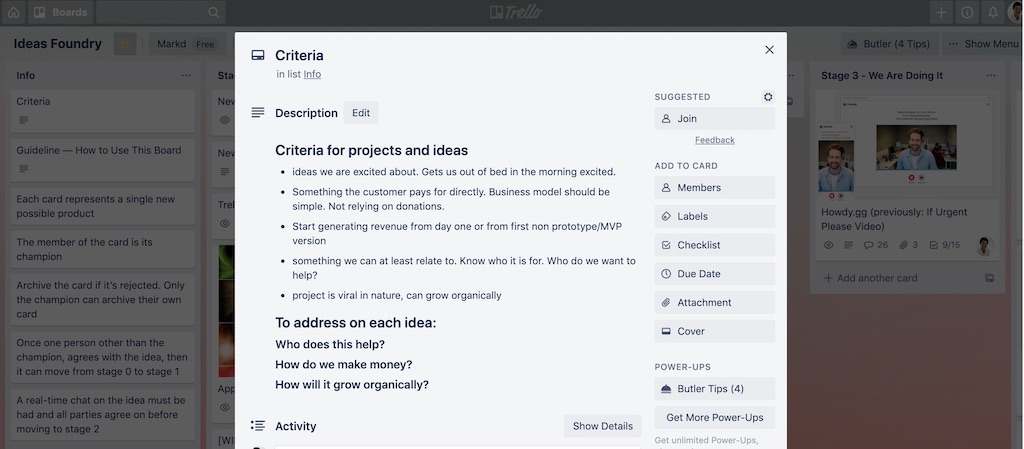
<p>I want this to be as transparent so I am copying it directly from our “Ideas Foundry” board so excuse the lack of polish to the language.</p>

<blockquote>

  <h1 id="criteria-for-projects-and-ideas">Criteria for projects and ideas</h1>
  <ul>
    <li>ideas we are excited about. Gets us out of bed in the morning excited.</li>
    <li>Something the customer pays for directly. Business model should be simple. Not relying on donations.</li>
    <li>Start generating revenue from day one or from first non prototype/MVP version</li>
    <li>something we can at least relate to. Know who it is for. Who do we want to help?</li>
    <li>project is viral in nature, can grow organically
      <h2 id="to-address-on-each-idea">To address on each idea:</h2>
    </li>
    <li>Who does this help?</li>
    <li>How do we make money?</li>
    <li>How will it grow organically?</li>
  </ul>
</blockquote>

<p>Let me walk you through this.</p>

<h3 id="ideas-we-are-excited-about">Ideas we are excited about</h3>

<p>This is all about the sustainability of our energy to focus on one project.</p>

<p>Some ideas are potentially very profitable, but it might not be an area we want to spend our time on (ex. gambling).</p>

<p>Some are interesting but we know we woulds lose interest after the initial rush of excitement. These are ideas where it’s more exciting to come up with new solutions than actually implementing the solutions. (ex. new ways to transfer money between different currencies via blockchain). These are also ideas where we are intrigued by the technology more than the practicality.</p>

<h3 id="simple-business-models">Simple business models</h3>

<p>We want to focus our attention away from figuring out how to extract the most value out of our products.</p>

<p>I am not against making the most profit our of an idea. However with our limited resource, we have to choose our battles and we’ve decided that by keeping business models simple, we can better judge the value of our products and focus on building the right products based on these values, rather than spending time creating complex deals involving many third parties.</p>

<p>When people pay us directly, we know they consider our ideas of value.</p>

<h3 id="early-revenue">Early revenue</h3>

<p>This is connected to the simple business model criteria. The sooner we can find out how many people find value in it (by paying for it), the sooner we know if the product is useful or entertaining to people. Without this, the qualitative (and even quantitative) feedback on the ideas/products can often be misleading.</p>

<p><img src="/uploads/criteria-for-deciding-on-ideas-notext.jpg" alt="idea criteria on trello board" /></p>

<h3 id="relatability">Relatability</h3>

<p>For some of our earlier products, we relied heavily on interviews with users in a sector that we are hugely unfamiliar with. It wasn’t intentional, we simply found that there’s a bigger demand from this group of people than what we had originally envisioned.</p>

<p>However the difficulty is that 2-hand information can be hard to fully incorporate into the product. We were often second-guessing what they wanted. Worst yet, we built what they said they wanted, and realised these new features and updates did not move the needle (they didn’t use the features despite asking for them repeatedly).</p>

<p>So we decided we should at least have some basic domain knowledge in the ideas we are exploring. I know this isn’t what the lean methodology might suggest, but it’s something we have to do given our limited resources to work in areas that we understand so that we don’t have to spend a lot of time back and forth trying to figure out the demand and the market.</p>

<h3 id="virality">Virality</h3>

<p>Without a marketer on the team, marketing is always top of mind fo us.</p>

<p>We have experimented different marketing activities, ranging from <a href="https://blog.markd.co/2018/11/29/coldemailtemplate-cc-a-product-as-marketing-experiment-featured-on-producthunt.html">engineering as marketing</a>, social marketing, online ads, to content marketing (on and off our own sites).</p>

<p>Some of them worked better than others, but we’ve decided that for a product to really have significant growth potential, we need a way for it to grow organically, be it an invite system to get your team/friends/family to join, or social features where people would spread the words about the product naturally.</p>

<h2 id="questions-for-ourselves">Questions for ourselves</h2>

<p>To assist us in satisfying these criteria, we came up with 3 questions that we need to ask ourselves to with new ideas.</p>

<p><em>Who does this help?</em> — gives us an indication of how well we know about the market.</p>

<p><em>How do we make money?</em> — gives us a quick overview of the business model</p>

<p><em>How will it grow organically?</em> — answers the question about the potential growth of the product.</p>

<h2 id="first-idea-that-satisfied-the-criteria">First Idea that Satisfied the Criteria</h2>

<p>The first idea that passed the criteria is <a href="https://howdy.page">Howdy.page</a> — a service for people to receive video messages with customisable URLs.</p>

<p><a href="https://howdy.page"><img src="/uploads/howdy-page–shadow-w1024.jpg" alt="howdy.page" /></a></p>

<p><em>Who does this help?</em> — people overwhelmed with emails, particularly automated emails, people who are looking for an alternative way to be contacted, one that’s more engaging and more <em>human</em>. I am terrible at managing my emails, and one of the reasons is that a large portion of my emails are either 1. automated, pre-written, or 2. not personal enough to read. I crave the off-line, face-to-face communication, and I think this helps bring some of that magic back to the digital world.</p>

<p><em>How do we make money?</em> — we charge people a monthly fee for the service. No ads, no selling any information.</p>

<p><em>How will it grow organically?</em> — the way the product works is that users create pages that they can use to receive video messages, so naturally these pages are shared and shown to their audience and network. We hope this helps brining in a bit of visibility to the service, and after people record a video, we’d take the opportunity to ask if they might be interested in joining.</p>

<h2 id="after-the-criteria">After the criteria</h2>

<p>After the idea passed the criteria, we ran it through some more demand testing which I will write about in the future. Suffice to say that we feel confident enough about the idea that we went ahead and started planning and developing it from about two months ago.</p>

<p>Will this work? We will find out in a few months. (If you are interested in using Howdy before it’s public, you can sign up at <a href="https://howdy.page">howdy.page</a>) However, regardless of the outcome of Howdy, I believe the criteria is a good first pass to help us think through ideas, particularly ideas that can fit this particular team at <a href="https://markd.ltd">Markd</a>.</p>

]]></description>          
          <pubDate>Fri, 22 Nov 2019 00:00:00 +0000</pubDate>
          <link>https://brandonwu.co/2019/11/22/criteria-for-deciding-on-ideas.html</link>
          <guid isPermaLink="true">https://brandonwu.co/2019/11/22/criteria-for-deciding-on-ideas.html</guid>
        </item>
      <item>
          <title>My New Favourite Toys (creative apps, web apps) August 2019</title>
          <description><![CDATA[<p><img src="/uploads/my-new-favourite-toys-creative-apps-web-apps-august-2019.jpg" alt="My New Favourite Toys Creative Apps Web Apps August 2019" /></p>

<!-- ## My New Favourite Toys (apps, web apps) August 2019 -->
<h3 id="unfollow-tool"><a href="https://tokimeki-unfollow.glitch.me/">Unfollow tool</a></h3>
<p><a href="https://tokimeki-unfollow.glitch.me/"><img src="/uploads/tokimeki-unfollow.jpg" alt="tokimeki unfollow" /></a>
Tokimeki Unfollow is a fun web app that helps you trim down your Twitter following. Without showing you the bios of people you are following on Twitter, you have to decide to keep following someone or not based on their recent tweets. I liked the personality of the app (too few social media tools have a personality!)</p>

<h3 id="olive-video-editor"><a href="https://www.olivevideoeditor.org/">Olive video editor</a></h3>
<!--more-->
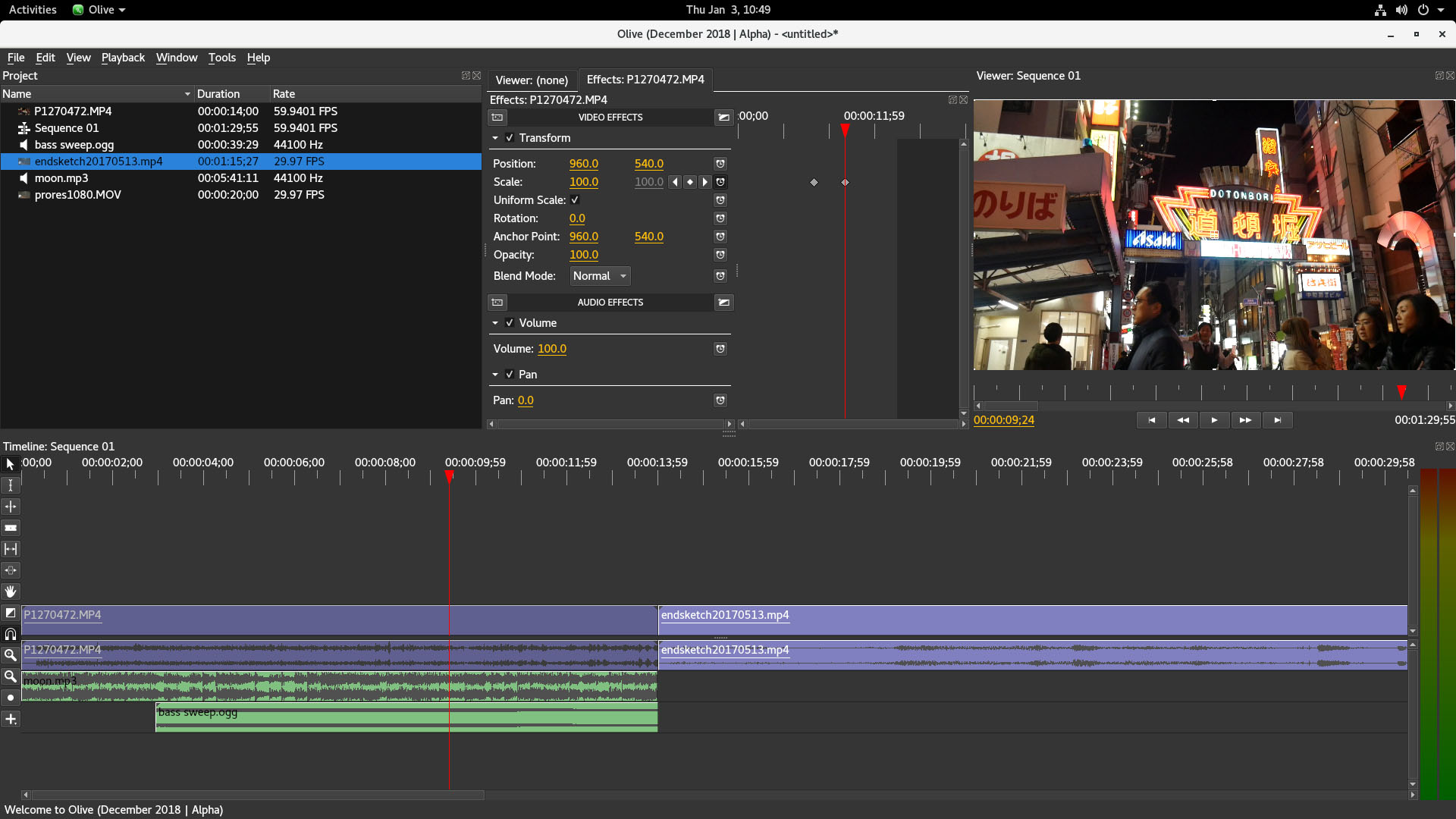
<p><a href="https://www.olivevideoeditor.org/"><img src="/uploads/olive.jpg" alt="Olive video editor" /></a>
I found Olive video editor from <a href="https://twitter.com/lgworld">Libre Graphics World</a>, where I find info on open source creative software. It’s a free/open-source video editor that’s more powerful (and easier to use imo) than iMovie, and fairly stable for what I needed to do - short tutorial and promotional videos.</p>

<h3 id="logic-pro-x"><a href="https://www.apple.com/uk/logic-pro/">Logic Pro X</a></h3>
<p><a href="https://www.apple.com/uk/logic-pro/"><img src="/uploads/logic-pro-x.jpg" alt="Logic Pro X" /></a>
I’ve been thinking about going back to creating music for the longest time. It’s something I enjoy doing, but always hesitate to do more of/with it (for no good reason).</p>

<p>I happened to turn on the TV one evening while trying to get our new born baby to sleep, and saw <a href="https://www.bbc.co.uk/events/er3v9r/acts/an54rz">Jon Hopkin’s live Glastonbury gig</a> on BBC. I felt instantly inspired and curious, and decided to look into music production again.</p>

<p>I’ve tried Ableton Live a few times over the years, and really like the <a href="https://www.ableton.com/en/manual/session-view/">Session View</a> feature. However I know I want to, at some point, work with physical instruments and Logic seems to be well-suited for that. Not to mention that I found that Jon Hopkins uses Logic Pro X. ;)</p>

<h3 id="defold"><a href="https://www.defold.com/">Defold</a></h3>
<p><a href="(https://www.defold.com/)"><img src="/uploads/defold.jpg" alt="Defold" /></a>
I’ve always been a Unity user since 2009. It’s a familiar tool and one that I’ll always enjoy using. On the other hand, I am curious about new creative tools. I learned about Defold from <a href="https://www.youtube.com/user/gamefromscratch">Gamefromscratch</a>. It’s a free 2D/2.5D game engine that’s particularly suitable for web games. I went through the beginning tutorials - certainly got great potential imo for a few ideas I had from the past! It’s fairly easy to start with, and I like the hot reload (!), the built-in IDE, and an event system that’s at the core of how you build your project.</p>
]]></description>          
          <pubDate>Thu, 08 Aug 2019 00:00:00 +0000</pubDate>
          <link>https://brandonwu.co/2019/08/08/my-new-favourite-toys-creative-apps-web-apps-august-2019.html</link>
          <guid isPermaLink="true">https://brandonwu.co/2019/08/08/my-new-favourite-toys-creative-apps-web-apps-august-2019.html</guid>
        </item>
      <item>
          <title>TalentSearch.cc bombed on ProductHunt</title>
          <description><![CDATA[<p><img src="/uploads/talentsearch-cc-bombed-on-producthunt.jpg" alt="TalentSearch.cc Bombed on ProductHunt" /></p>

<p>So TalentSearch.cc <a href="https://www.producthunt.com/posts/talent-search">bombed on ProductHunt</a>.</p>

<p>It didn’t get nearly as many votes or as much attention as <a href="https://coldemailtemplate.cc/">ColdEmailTemplate.cc</a> or <a href="https://markd.co/">Markd.co</a>, both were featured on the front page. I was overly confident in how useful <a href="https://talentsearch.cc/">TalentSearch.cc</a> is for people (who wouldn’t want a search bar to find talents on multiple social platforms?!) and how popular it will be for the PH community, which also meant I spent way more time on it than ColdEmailTemplate.cc.</p>

<!--more-->

<p>But it completely bombed on ProductHunt. Just over 10 votes, one comment. Despite the gif logo I was proud of, and the strategic scheduling I planned…</p>

<p>However, TalentSearch did well on Reddit - a platform that I was always hesitant to get on. People on recruiting subreddits loved it. It got lots of votes, attention, comments, and a follow up phone call with a potential partner. I also got Reddit Gold for the first time from the posts (I had no idea what it was).</p>

<p>I am not sure what the take-away is. Perhaps it’s that we should come out of our bubbles and explore other communities. I admit I spend too much time in the “startup” community and that can lead to huge bias and also lost opportunities.</p>

<p>Perhaps it’s about the importance of learning about the different pockets of communities online. ProductHunt is great for productivity apps for hackers, developers, founders, but a tool that’s more suitable for HR and recruiters, perhaps people there just aren’t that interested. On the other hand, I’ve not had great success on Reddit from their startup communities, and that had put me off for a long time. Fortunately I decided to give different subreddits a try and found that within a platform as big as Reddit, each subreddit has its own culture and it’s important to understand that.</p>

<p>Perhaps it’s also about confidence and intuition. My intuition and confidence isn’t always the best indicator for a product’s success (I should know this by now), particularly one that I don’t have a constant need for. Sure I look for people to hire from time to time, but not being a recruiter who needs to find people on a daily basis, I do not understand how they use tools, where they hang out (apparently not on ProductHunt), and how best to approach them.</p>

<p>There’s also good learning for me on the actual development of the tool, which I should write about in another post - how I over-engineered a simple product ;)</p>

]]></description>          
          <pubDate>Wed, 07 Aug 2019 00:00:00 +0000</pubDate>
          <link>https://brandonwu.co/2019/08/07/talentsearch-cc-bombed-on-producthunt.html</link>
          <guid isPermaLink="true">https://brandonwu.co/2019/08/07/talentsearch-cc-bombed-on-producthunt.html</guid>
        </item>
      <item>
          <title>Tidy Up Your Following — The 100-Following Rule</title>
          <description><![CDATA[<p><img src="/uploads/tidy-up-your-following.jpg" alt="The 100-following rule" /></p>

<p><em>Why We should KonMari Our Social Follows</em></p>

<p>—</p>

<p>A number of years ago I read Kevin Kelly’s essay on <a href="https://kk.org/thetechnium/1000-true-fans/">1,000 True Fans</a>. The idea that if you can find and grow an audience of 1,000 true fans that love what you do, you can be financially independent as a creative maker.</p>

<p>I liked this theory, and decided I will put it to practice by reducing the number of people I follow on Twitter.</p>

<!--more-->

<p><em>What</em>? How does that help me get to 1,000 true fans you might ask.</p>

<p>I tend think in <a href="https://sivers.org/counter">opposites</a>, and when I learned about the theory of 1,000 true fans, my first thought was — how would the people I am a fan of know if they’ve got 1,000 true fans if I am following both my heroes, and also people who I find interesting but not really a true fan of? So I decided to create a 100-following rule — if everyone is limited to only following up to 100 people, we’d all be able to identify our fans and heroes much easier.</p>

<p>Social media is a great way to manage fans in theory. People like what you do, and they <strong>follow</strong> you. I have discovered and followed more YouTube creators in the past year - many of whom I truly admire their talents in storytelling , analysis, and in videography.</p>

<p>In practice however, we follow people on social media for other reasons than what they create. Perhaps you feel obligated to follow someone you know simply to reciprocate. Or you follow a celebrity in your industry because everyone else is following them and you don’t want to miss out.</p>

<p>Or sometimes you just want to remember someone who seem to be doing cool things. Even though you might not enjoy the content they produce on the specific social platforms (tweets, photos, videos…etc.). Not everyone who works on cool projects are great at social media — they might be tweeting things you care little about other than the cool projects you are interested in.</p>

<p>The problem with following people you are not a true fan of is that the noise prevents you from seeing content from your heroes. It prevents social platforms from doing what it’s great at - building those meaningful connections between fans and creators.</p>

<p>Twitter is my main social tool. I use it to learn all things new and interesting in tech, software, indie games, and economics/business. And I use the 100-following rule there, limiting the number of people I follow to 100 people whose tweets I truly value. For friends and professional contacts, I rely on other tools (Facebook, Linkedin, messenger apps…etc.), and for people who I find interesting and just want to bookmark and be able to find them later, I save them on <a href="https://markd.co/?ref=brandonwu.co">Markd</a>.</p>

<p>I found a great tool to trim Twitter following on <a href="https://glitch.com/">Glitch</a> (lots of wonderful little apps and coding projects on there). It’s called <a href="https://tokimeki-unfollow.glitch.me/">Tokimeki Unfollow</a> — <em>KonMari your Twitter follows</em>. It shows only tweets from people you are following when asking you if you want to keep following them, hiding their bio so that you are making the decision only from the content.</p>

<ul>
  <li><strong>Tokimeki Unfollow</strong> — <em>KonMari your Twitter follows</em>
    <ul>
      <li>App: <a href="https://tokimeki-unfollow.glitch.me/">https://tokimeki-unfollow.glitch.me/</a></li>
      <li>Code and info: <a href="https://glitch.com/~tokimeki-unfollow">https://glitch.com/~tokimeki-unfollow</a></li>
    </ul>
  </li>
</ul>

<p>Do your heroes a service and trim your following!</p>
]]></description>          
          <pubDate>Fri, 31 May 2019 00:00:00 +0000</pubDate>
          <link>https://brandonwu.co/2019/05/31/tidy-up-your-following-the-100-following-rule.html</link>
          <guid isPermaLink="true">https://brandonwu.co/2019/05/31/tidy-up-your-following-the-100-following-rule.html</guid>
        </item>
      <item>
          <title>Mensch Patterns</title>
          <description><![CDATA[<p><img src="/uploads/mensch-patterns.jpg" alt="Mensch Patterns" /></p>

<p>At <a href="https://businessofsoftware.eu/2019/05/slides-highlights-notes-from-business-of-software-conference-europe-2019/">Business of Software</a> conference last month, I sat in a talk by <a href="https://sivers.org/">Derek Sivers</a> and learned about Mensch Patterns, his antidote to the inescapable <a href="https://www.darkpatterns.org/">Dark Patterns</a> so prevalent on the web today (tricks that make users do things that they didn’t mean to).</p>

<!--more-->

<p>I like the idea of Mensch Patterns, essentially over-compensating for Dark Patterns by being incredibly customer oriented. If we treat our customers how we’d like to be treated and respected, and focus on making what we do better and more valuable to them, our long-term interests are aligned, and all the things we want in the business — retention, loyalty, awareness, will come out of this.</p>

<p>Is it too naive to believe in this? Perhaps. However, the more time we spend doing something, the better we get at it. Do we want to get better at tricking people to use/buy our products, or get better at making our products and services great and building a strong relationships with our customers?</p>

<p>It’ll take longer to build growth and retention, trust and loyalty, without the clever tricks of Dark Patterns. But if you are thinking long-term like I am after this talk, I think it’s absolutely worth the time to find, practice, and perfect our own Mensch Patterns.</p>

]]></description>          
          <pubDate>Thu, 02 May 2019 00:00:00 +0000</pubDate>
          <link>https://brandonwu.co/2019/05/02/mensch-patterns.html</link>
          <guid isPermaLink="true">https://brandonwu.co/2019/05/02/mensch-patterns.html</guid>
        </item>
      <item>
          <title>Marketing Sucks</title>
          <description><![CDATA[<p><img src="/uploads/marketing-sucks.jpg" alt="Marketing sucks" /></p>

<p>Marketing Sucks.</p>

<p>Marketing sucks, big time.</p>

<p>You push and pull and try to get known. You obsess over views and votes and all the likes you didn’t get.</p>

<!--more-->

<p>Marketing sucks.</p>

<p>It sucks, big time.</p>

<p>You read the case studies of marketing successes to feel small, and study the tactics of growth hacks to feel overwhelmed.</p>

<p>Marketing sucks, big time.</p>

<p>It’s a road with no end. You need to keep going before you find gold because there’s always one more thing to try, and you need to keep going after you’ve found gold because competition is just behind.</p>

<p>There’s SEO there’s content, there’s social and there’s paid ads. Have you found your influencers yet and have you talked to the press. Where is your community and what’s your TA.</p>

<p>Marketing sucks.</p>

<p>Marketing sucks, big time.</p>

<p>Until,</p>

<p>Until you see one, and two, and three people using what you’ve built. Until you hear one, or two, or three people asking for more.</p>

<p>Until you realise it’s not about the tactics, but them; the people who you think you can help in one way or the other, the people you connect with through a shared experience - a product, a service, an emotion.</p>

<p>Then,</p>

<p>Then it sucks a little less, and a little less, and a little bit less.</p>
]]></description>          
          <pubDate>Wed, 13 Mar 2019 00:00:00 +0000</pubDate>
          <link>https://brandonwu.co/2019/03/13/marketing-sucks.html</link>
          <guid isPermaLink="true">https://brandonwu.co/2019/03/13/marketing-sucks.html</guid>
        </item>
      <item>
          <title>Feeling Anxious? Try Writing</title>
          <description><![CDATA[<p><img src="/uploads/feeling-anxious-try-writing.jpg" alt="Feeling anxious? Try writing" /></p>

<p>A couple of weeks ago on a Saturday, I was feeling anxious. For no apparently reason, it was one of those days when you couldn’t think of anything to feel down about, but feel down nonetheless.</p>

<p>So naturally to “fix” this, I made coffee. One cup of coffee, didn’t work. Two cups of coffee, didn’t work. Green tea? Didn’t help either. By mid afternoon, I was high on caffeine but low on mood.</p>

<!--more-->

<p>I had really wanted to draft a blog post that day. So even though I really couldn’t be bothered, knowing that the only chance I had was during Georgie’s nap time, I forced myself to sit down at the kitchen table and started typing away.</p>

<p>And by the time I finished writing the post, my mystery anxiety had gone. I felt awake. I could hold a conversation. My head was no longer foggy. And other than having to pee every half an hour due to the amount of coffee and tea I had consumed earlier, I felt normal again.</p>

<p>I knew about the benefits of writing a gratitude journal, where you write down things you are thankful for. But this was a different experience. I wasn’t writing anything meditative, the article I drafted was about <a href="/2019/01/14/wordpress-to-jekyll.html">migrating WordPress sites to Jekyll</a>. But the calming effect of writing was effective nevertheless.</p>

<p>It didn’t matter what the subject was. It was the act of writing itself that mattered.</p>

<p>A new life hack I learned that day. One that will come in handy as we prepare for the arrival of a second little cheeky monkey.</p>
]]></description>          
          <pubDate>Mon, 28 Jan 2019 00:00:00 +0000</pubDate>
          <link>https://brandonwu.co/2019/01/28/feeling-anxious-try-writing.html</link>
          <guid isPermaLink="true">https://brandonwu.co/2019/01/28/feeling-anxious-try-writing.html</guid>
        </item>
      <item>
          <title>Moving My WordPress Sites to Jekyll</title>
          <description><![CDATA[<p><img src="/uploads/moving-my-wordpress-sites-to-jekyll.jpg" alt="moving wordpress sites to jekyll" /></p>

<p>Towards the end of 2018, I had the urge to “tidy up” my mental space to make room for <a href="https://markd.co/">Markd</a>, and I decided to close down the numerous websites I’d had created and accumulated over the years.</p>

<p>For the sites that I do want to keep, I wanted them to be smaller sites, simpler projects.</p>

<p>For years I’d been using Wordpress for websites. It’s a powerful CMS that allowed me to get set up and running quickly. The massive plugin eco-system meant I could add the latest features fo these sites without technical knowledge. The themes let me create websites that looked nice without worrying about designing them myself.</p>

<p>But it also came with a cost. Plugins and themes constantly required updating. And dealing with spam was always an issue for some of my bigger sites. Maintenance became a bit of a headache, and with so many different plugins for different sites, it  got overwhelming.</p>

<!--more-->

<p>Inspired by my <a href="https://markd.co/">Markd</a> co-founder Mike’s <a href="https://mikecann.co.uk/blog/the-static-blog/">blog post about moving to static sites</a>, I started looking into turning this blog (along with my <a href="https://www.30daygmatsuccess.com/&quot;">GMAT book website</a>) into static websites. I don’t need a lot of features for these sites, so I can do without the massive WordPress plugins ecosystem. Design-wise I only wanted something clean and simple. Static sites also load faster, and new offerings like Netlify makes it easy to build, deploy, and launch sites.</p>

<p>I’d also been getting more comfortable with coding since I had to make these sites 7-8 years ago. Although I’d been mostly working with C# (for Unity) and not web programming languages like JavaScript or Ruby, I felt comfortable enough to give this a try.</p>

<p>I decided on Jekyll relatively quickly for its integration with Github Pages. Although I quickly move the site to Netlify, it gave me a safe playground to start the projects with.</p>

<p>It’s certainly a bit more technical compared to setting up Wordpress sites. However it gave me a chance to learn the basics of how websites actually work. I had never worked with Ruby before so it’s also quite a good introduction to it. Although I have to say I mostly just followed tutorials without learning the fundamentals. :p</p>

<p>Instead of writing yet another tutorial, I’ll send you to this article by Netlify <a href="https://www.netlify.com/blog/2015/10/28/a-step-by-step-guide-jekyll-3.0-on-netlify/">A Step-by-Step Guide: Jekyll 3.0 on Netlify</a> and <a href="https://blog.webjeda.com/wordpress-to-jekyll-migration/">4 Steps To Migrate From WordPress To Jekyll</a>.</p>

<p>Some notes:</p>
<ul>
  <li>Use <a href="https://wordpress.org/plugins/jekyll-exporter/">this plugin</a> to export your WordPress pages and posts</li>
  <li>I struggled with themes and plugins when hosting on Netlify. They aren’t automatically <em>/installed/bundled</em>, unlike on Github, so it takes a bit of trial and error for me. Read Jekyll’s documentation on plugins <a href="https://jekyllrb.com/docs/plugins/installation/">here</a> (note that for option 2, after adding text to _config.yml, there’s an extra step below which I missed the first few times I read it. )</li>
  <li>I can’t believe Netlify is free. FREE. It’s an incredible service. AND FREE!</li>
  <li>I moved away from Cloudflare to use Netlify’s domain manager. So far it’s been quick and easy. Great for setting up https as well.</li>
  <li>Remember to double check on your Google Search Console to make sure Google can still crawl your sites properly, and set up redirects when you need to.</li>
  <li>Actually, setting up redirects took much longer than I thought it would. But mainly because for brandonwu.co I had a few different domain alias and broken links.</li>
  <li>I set up <a href="https://forestry.io/">forestry.io</a> on a few of these sites. However I’ve found it to be easier for me to write with Visual Studio Code + Git to publish. I draft blog posts in markdown on whatever markdown editor I happen to have on the device I am writing in. (I should write another post about how I write notes/drafts and sync them)</li>
  <li>One other huge benefit is to be able to batch-edit pretty much anything I need to. Just Find and replace in Visual Studio Code!</li>
</ul>

<p>The only downside so far is not being able to publish on mobile, since publishing requires committing changes to the repository. I probably could use <a href="https://forestry.io/">forestry.io</a> to do it but I haven’t explored that option.</p>

<p>I am very happy with the result. The sites load very fast, and so far appears simple to maintain. It’s also nice to have so much control / customisation on the sites, a degree of freedom I never felt with WordPress sites. Not having to rely on a 3rd-party plugin for every little thing is liberating.</p>

<p>I’d certainly recommend looking into static sites if you also feel overwhelmed by a more traditional CMS.</p>
]]></description>          
          <pubDate>Mon, 14 Jan 2019 00:00:00 +0000</pubDate>
          <link>https://brandonwu.co/2019/01/14/wordpress-to-jekyll.html</link>
          <guid isPermaLink="true">https://brandonwu.co/2019/01/14/wordpress-to-jekyll.html</guid>
        </item>
      <item>
          <title>Blog is blog</title>
          <description><![CDATA[<p><img src="/uploads/seattle-south-lake-union.jpeg" alt="Seattle South Lake Union" /></p>

<p>Ten years ago, I had a blog. It was in mandarin and hosted on a popular blogging platform in Taiwan.</p>

<p>I wrote anything that came to mind. I wrote about the passing of my grandmother. I wrote about life in Japan. I wrote about new learnings. I wrote personal thoughts. I wrote poems.</p>

<p>Then I left my job to start a business. And all of a sudden, blogging becomes part of that. I thought I needed to write about business, technology, and whatever else good for SEO / personal brand …etc. 
<!--more--></p>

<p>I also stopped writing very often. I was afraid that my posts weren’t professional. I worried about how my writing might impact my businesses. I over-thought, and I over-edited. I was worried about mistakes and poor impressions. Writing a blog post was no longer fun but laborious.</p>

<p>Yet the most popular posts are still ones from my personal experiences. The <a href="https://brandonwu.co/proposing-at-shibuya-crossing-the-time-i-almost-spent-10000-to-impress-a-girl/">Shibuya crossing proposal</a>, the <a href="https://brandonwu.co/how-a-simple-technique-helped-me-figure-out-what-i-want-to-do-with-my-life/">interview I gave myself to figure out my career goals</a>.</p>

<p>I’d like to make some changes. Going forward, business is business; blog is blog.</p>

<p>I will write and share my thoughts, ideas, life, and learnings once again. You can still find the professional me elsewhere, but this blog, it’s once again personal.</p>

<p>You’ll find out more about the real me. The behind-the-scenes. It’ll be less polished. It’d be less businessey. It’d likely be about parenting and kids often.</p>

<p>And I am hopeful you’ll see a lot more of it.</p>
]]></description>          
          <pubDate>Mon, 07 Jan 2019 00:00:00 +0000</pubDate>
          <link>https://brandonwu.co/2019/01/07/blog-is-blog.html</link>
          <guid isPermaLink="true">https://brandonwu.co/2019/01/07/blog-is-blog.html</guid>
        </item>
      <item>
          <title>8 Quick Tips to Manage Creative Teams and People</title>
          <description><![CDATA[<p>I manage creative teams at our game studio and work with many independent game and app developers, people who passionately and happily spend their free time turning their impulsive ideas into playable experiences. They are programmers that can’t stop tinkering, and artists that can’t stop drawing (or modelling, animating…etc.) — highly talented people that live for creating and crafting their art.</p>

<p>These tend to be the most motivated bunch, and they also tend to have deep domain expertise because they have spent not just their work hours on improving their skills but also their precious evenings and weekends. I am often amazed at how talented these people are, and if you spend even just seconds talking to them, you soon realise how addicted they are to their tools, their thoughts, and their creations.</p>

<p>They can also be some of the most difficult people you’ll manage.</p>

<p>Why? Let’s look at some of the overlapping traits of many highly creative people:
<!--more--></p>
<ul>
	<li>Non-comformative</li>
	<li>High personal output</li>
	<li>Dedicated</li>
	<li>Opinionated</li>
	<li>Confident in her craft</li>
	<li>Higher ego</li>
	<li>Free spirited</li>
	<li>Gets bored easily</li>
	<li>Multi-passionate</li>
	<li>Jumps from idea to idea</li>
	<li>Places less focus on finance</li>
	<li>Frustration when others “don’t get it”</li>
	<li>Disregards for structure and management</li>
</ul>
<p>They amaze you with their incredible talent, but can frustrate you with their unique approach to work. This is especially obvious if your project has a corporate client on one side, and a creative-thinking team on the other. One is focusing on their corporate metrics, the other on the artistic expression.</p>

<p>So how do we deal with this conundrum? Here are some of the most effective ways I’ve found to help manage highly creative talents:</p>
<ol>
	<li><strong>Acknowledge their knowledge and know-how.</strong> Creative talents have huge pride in what they do. Acknowledge the importance and brilliance in what they proposed and produced. (And if you don’t find them to be impressive, it might be a good idea to part ways quickly.) You’ve found the best creative talents for your projects, don’t be cheap in giving props - many artists live for the applause.</li>
	<li><strong>Align individual goals with the organisational goals.</strong> Find out the true motivation behind each talent. Some love the purity of a creative project — clean codebase, streamlined pipelines, while others may care the most about the tools they use or the protocols they follow. Some care about their reputation in a specific community, while others may care more about having a say in the design. I often find monetary motivations aren’t necessarily high on the list of priorities for creative workers. Communicating the bigger picture to artists can help keep everyone on the same page and work towards the same goal. It’s not always obvious for creatives who spend their time crafting and tweaking to understand or care about the why behind each project. Make sure it’s obvious and communicate this early on.</li>
	<li><strong>Buffer for freedom to express.</strong> Build in buffers, both in terms of budgeting and time, to allow people to experiment and toy with new ideas related to the project. Most of these experiments will not be included in the final deliverable, but there is always great learnings to gain from them, and the boost to moral is a huge benefit to keep the team engaged. Creatives aren’t motivated by money but by self-expression, so show them you understand and appreciate what makes them creative in the first place.</li>
	<li><strong>Listen, and let time take care of issues.</strong> Creatives will clash, either with other creatives in the team or with the client of the projects, internal or external. First, listen to what they want to express and spend time to understand the issues. But don’t act on a fix right away. I’ve found that often times people will calm down and the issues would go away after a night of sleep, especially if they understand the bigger picture (see point 2). Although the immediate response to a clash might make people hot-headed, if people feel they are listened to and their concerns considered, they are most likely be calm down and compromise.</li>
	<li><strong>Be a leader, not a boss. </strong>Lead the direction of the project but don’t boss people around. Let the creatives have control over their areas of responsibilities. It’s tempting to get “hands-on” if you have a creative background as well, but the more micro-managing you do, the less interested highly creative talents become. Creative workers don’t work well with strict rules and guidelines. Define the overall direction, empower your team, and let them enjoy the work and the accomplishment.</li>
	<li><strong>Be specific with critique.</strong> There will be times when you have to challenge the work produced. Be specific with your comments and avoid being personal. Listen to the team to know why things are done a certain way, then offer your advice on how it can be improved or how it can be done differently to suit the need of the project. There aren’t always rights or wrongs with creative projects, but certain things will fit better with them, and if you are specific about these items, the critiques will be better received.</li>
	<li><strong>Get excited but keep your eyes on the ball.</strong> It’s hard not to get excited when a creative person is telling you about their latest exciting creation. After all, new art is the fuel to their drive. Enjoy the excitement with them. At the same time, you have to be the one keeping an eye on the schedule, objectives and resource constrains, and you also need to be keeping the team away from adding too many cool new things to the todo list if it's going to take you off piste.</li>
	<li><strong>Have fun - and be a rock.</strong> A creative team can be one of the most fun groups of people you'll ever work with, with its high energy and constant stimulation. The highs and lows can also be fairly dramatic in a high-energy, free-spirited team. As well as riding the fun times with them, make sure you play the role of a rock solid support the team can count on to keep calm and carry on during the tougher times.</li>
</ol>
<p>Working with creative people is one of the most rewarding parts of my job, and if you manage creative teams right, I bet you feel the same!</p>

<p><em><strong>Thoughts? Experiences? Agree / Disagree? Let’s discuss!</strong></em></p>
]]></description>          
          <pubDate>Wed, 27 May 2015 08:40:45 +0000</pubDate>
          <link>https://brandonwu.co/8-quick-tips-to-manage-creative-teams-and-people/</link>
          <guid isPermaLink="true">https://brandonwu.co/8-quick-tips-to-manage-creative-teams-and-people/</guid>
        </item>
      <item>
          <title>Calculating the Game Engine Market Size &amp;#8211; Determine the Market Size for Game Engine Software</title>
          <description><![CDATA[<p>This question on Quora "<a href="https://www.quora.com/How-do-I-determine-the-consumer-market-size-for-game-engine-software" target="_blank">How do I determine the consumer market size for game engine software?</a>” peaked my interest. Here’s <a href="https://www.quora.com/How-do-I-determine-the-consumer-market-size-for-game-engine-software/answer/Brandon-Wu" target="_blank">my reply</a>:</p>
<hr />

<h2>Determine the game engine market size</h2>
<h3>VALUE vs REVENUE</h3>
<p>Before we start estimating the market size for game engines, let's decide exactly what we want to find out - is it the VALUE game engines generate, or the REVENUE?</p>
<p><strong>REVENUE</strong> is the about of money spent on game engines, <strong>VALUE</strong> is how much value, in dollar-terms, game engines create. VALUE is the <strong>REVENUE potential</strong> for the game engine industry. (Note: it is possible for REVENUE to exceed VALUE if the value chain around the industry has the capacity for it.) REVENUE is determined by how much of that value is captured by game engine companies today.</p>
<p>For example, you hire a personal assistant to help you draft an email. You pay the assistant $25 for drafting the email, which would have taken you half an hour if you were to write it yourself during your work day. If you make $120 per hour during work hours, the personal assistant has saved you half an hour - which has the value of $120x0.5hr=$60 (VALUE generated by assistant). However you only paid the assistant $25 for the work (REVENUE).</p>
<!--more-->
<p>So in this example, for the "email drafting market by this PA" is:</p>

<ul>
<li>Value: $50</li>
<li>Revenue: $25</li>
</ul>
<p>The model you create differs depending on which one you are estimating. For game engines, Value will include value of internal game engines (tools and middleware built in-house in game companies to produce their own games - how much time and cost are saved from these) while Revenue will be mostly sales from game engine companies.</p>
<h3>Market Sizing Steps</h3>
<p>In general, estimating a market consists of three basic steps:</p>
<ol>
<li>Define the model/formula</li>
<li>Make assumptions</li>
<li>Validate assumptions</li>
</ol>
<h3>Model - REVENUE</h3>
<p>Let's assume we want to find out the revenue generated from selling game engines. There are in general two ways to model your estimate: Top-down vs Bottom-up.</p>
<h4>Top-down</h4>
<p>A top-down approach essentially means you start from the top - a big number about a very broadly defined market, and then drill down to the specifically defined market you are estimating.</p>
<p>For example, you might say the total amount of money spent on B2B computer software is a $100 billion dollars (all numbers in this example are made up), and computer graphics related software is 10% of that, which gives you $10B. Then you find out that out of the $10B computer graphics B2B software, 5% is on 3D software, 2% on vector graphics, 7% on photo imaging, and 3% on animations. Let's say we want to look at 3D game engines only, we multiply $10B by 5% = $500 million. Finally, we found that 30% of all 3D software has features to create interactions - a key feature for games. So we multiply $500 million with 30% and get to $150 millions. That's our estimated market size for 3D game engines from a top-down approach in this example. Again all numbers are made up in this example.</p>
<p>You'll often have to figure out a way to define the percentages - make assumptions and validate them. It's rare to have all these numbers available to you. One way of finding these percentages is by looking at company annual reports and see how much they are spending on particular areas, or look at the sales numbers of all companies in one industry and benchmark against a different industry. Lots of creative ways to come up with these as long as you can back up your reasoning.</p>
<h4>Bottom-up</h4>
<p>A bottom-up approach starts from looking at the smallest unit of sales and then scale up. You evaluate how many potential buyers are out there (number of game companies, individuals game developers, non-gaming developers who might use game engines for other purposes...etc.), how much are they spending on average, where sales can take place (game engines + comparable substitutes), how often they are sold, how many distribution channels are available, how many international markets are game engines available, localization...etc. The list goes on and on but the point is with a bottom-up approach, you try to get to the top revenue number by scaling small set of sales continuously.</p>
<p>For example, let's say we want to estimate the market size (revenue) for game engines for board games. Let's start by finding out the number of board game production companies in the US - say 250 (all numbers are again made up in the example). They on average spend $1000 per developer every other year, and their average size is 5. So every year, each company spends $1000x5x(1/2) = $2500. That gives us 250x$2500 = $625,000 for all the companies in the US. Let's say we found out that US board game production companies represent 25% of all board game production companies in the world. Assuming all board game production companies spend the same amount in the world, $625,000/25% = $2,500,000 would be the world annual revenue for game engine for board games.</p>
<p>That is just one example of modeling using a bottom-up approach. There are many different ways you can structure your model / defined your formula. The bottom-up approach usually requires more work but can provide good solid foundations for your model.</p>
<h3>Model - VALUE</h3>
<p>Estimating the value game engines produce requires a bit of imagination - we want to find out not just how much money is spent on game engines but also the invisible VALUE that's been generated from these software - in-house engines, pirated copies, value generated from free/open-source middleware...etc.</p>
<p>Again, we can use either the Top-down approach or the Bottom-up approach. Let's do a quick thought exercise using the top-down approach:</p>
<p>Let's say the global mobile gaming market is $20B in 2014, and mobile represents 50% of total gaming market (again all numbers in the example are made up). That gives us a total of $50B for the consumer gaming market. $50B is the total VALUE generated from all the activities required to deliver all the games in the world into consumers hands. Now how much of that $50B can be attributed to game engines? Let's look at this rough value chain for the game industry:</p>
<p>Resources (capital) =&gt; Pre-production =&gt; Production =&gt; Distribution =&gt; Platform =&gt; Retail =&gt; Consumer</p>
<p>(Not a complete value chain for the industry - simplified and some layers might be overlapping and parallel to another.)</p>
<p>Each layer adds more value to the product until it reaches the consumer. If we know how much value each layer is attributing to the total value, we can start getting to know how much value game engines are responsible for.</p>
<p>Game engines are in the production layer. If we can say production accounts for 20% of the total value, and game engines account for 15% of the production layer, the VALUE game engines generate in the game industry would be $40Bx20%x15%=$1.2B.</p>
<p>How do we find out the percentage for each layer? This is where we'll have to make assumptions and try to back up our logic. Let's say Resources is $2B global invested amount in gaming. That accounts for 5% of the value (of the total $40B). Then we can look at big gaming companies and see how they spend their money - how much on pre-production, how much on production - to get a percentage of those two. For distribution, platform, and retail values, we can look at how much of a cut they take (ex. physical retail takes 50%, App Stores take 30%) to estimate their percentage of values attributed.</p>
<p>Again this is all very rough and numbers are for the most part made up in the examples.</p>
<p>The reason why I choose a top-down approach for the VALUE estimation is because this takes care of different ways game engines produce value. If we do a bottom-up approach, we will have to list out all the different ways a game engine can add value - in-house engine, open-source engine, art software with interactive features, different degrees of tools (ex.what do we consider an Engine and a Kit?)...etc. It can get pretty complicated very quickly. When we look at the value generated from an industry, most of the time we just want to get a sense of how big it is - so even though a top-down approach might not give you the granularity, it can give us a quick rough idea of what we need.</p>
]]></description>          
          <pubDate>Wed, 18 Jun 2014 17:32:24 +0000</pubDate>
          <link>https://brandonwu.co/game-engine-market-size/</link>
          <guid isPermaLink="true">https://brandonwu.co/game-engine-market-size/</guid>
        </item>
      <item>
          <title>A Desire to Create</title>
          <description><![CDATA[<p>A Desire to Create.</p>
<p>If you are like me, you spend your days with images of what can be in your head. You see things morphing into newer things. You find the possibilities of what can be created anew exhilarating. The missing imagination in mundane everyday things not only bores you, it infuriates you. You know it can be made better; they can all be, and you find it difficult to stop wanting to build, to shape, to create.</p>
<!--more-->
<p>And you feel the most alive when you do, as if it's the only thing that you are meant to do, and the only thing you are truly capable of doing.</p>
<p>When you see wonderful inspiring works, your mind wonders what else can be created from ideas, materials, and styles rooted in the work. You see the world in colors and sounds and movements, and thoughts and ideas and ideologies and meanings.</p>
<p>To create is not just to create but to express, to identify, to communicate, and to listen.</p>
<p>And to you, to create is not just to express, to identify, to communicate, or to listen. To create is to be.</p>
]]></description>          
          <pubDate>Tue, 03 Jun 2014 08:20:34 +0000</pubDate>
          <link>https://brandonwu.co/a-desire-to-create/</link>
          <guid isPermaLink="true">https://brandonwu.co/a-desire-to-create/</guid>
        </item>
      <item>
          <title>Things I Learned in an English Village</title>
          <description><![CDATA[<p><img style="display: block; max-width: 100%;" title="DSC00418.JPG" src="https://brandonwu.co/wp-content/uploads/2013/10/DSC00418.jpg" alt="DSC00418" width="600" border="0" /></p>
<p>Due to an unforeseen event, I am staying in a village in <a href="https://en.wikipedia.org/wiki/Midlands_(England)" rel="nofollow" target="_blank">the heart of England</a> for an extended period of time. For someone who has lived in big cities primarily, the village life is new to me. The buzzing streets and rush hour traffic jams are replaced by endless green fields, horses on the road, and farm/wild animals. A different way of life, and plenty of lessons for the technology-obsessed me: </p>
<!--more-->
<ul>
<li><strong>Location-based social network:</strong> everybody knows everybody, and there's no secret in the village. News of the accident (see first link above) spread from the local pub to everyone in the village. Word-of-mouth in its truest form. The benefit of knowing everyone is that there's a built-in reputation system as well - you know who to trust to be a genuine news source, and who are the gossipers. The close-knit hyper-personal network is one that's hard to emulate - the more local it is, the more personal it gets, a challenge all location-based mobile social networks have to overcome.  </li>
<li><strong>Farmville in the garden:</strong> real-life trees and flowers have a calming effect. I didn't get to click on icons to pick up rewards or coins, but the benefits are immediate and obvious to my senses - something one day biometric devices will probably be able to measure, and eventually come to the same result that we are better off spending time close to nature (and we all enjoy gardening - a creative activity of putting in efforts, growing a product, and seeing the blossoming results.) The social game aspect is also in place. You invite neighbors to your garden, which gives you a spirit booster. When you leave home for a vacation, the neighbors come around and help you water the flowers - keep ing them from withering. The game session is a lot longer - months/years as opposed to seconds, but you get to play a lot longer without constantly inserting coins. Can social games be designed to strengthen friendship and player loyalty via longer play sessions? </li>
<li><strong>UX at charity shops:</strong> used goods are donated to charity shops, where they are cleaned up, categorized, and sold, with proceeds going to charity. The practice exists elsewhere, but the charity shops in the English countryside are nicely decorated and present themselves as boutique stores - which helps with the public's perception of these shops, and there's no taboo in buying used clothes and goods. Instead of feeling cheap when shopping at a used good store, you are proud to support local charities and the UX reenforces that with a nice decor and information about the charities you are supporting. A good UX can dramatically change consumer perception and behavior. </li>
<li><strong>To create and to gift:</strong> People make chutney, cordial, pies, cakes…etc. (and often give fruit and veg from each other's gardens), to gift to each other. They don't do it for money, they do it for fun - the joy is in the making and the learning. Give your users ways to express themselves creatively, to gift their work, and to learn to get better at making things. Additionally, the gifting culture contributes to building a strong local social network (see first point). User-generated-content systems can benefit from focusing on both creative tools and a positive gifting culture to encourage more creative activities.</li>
<li><strong>Remember life:</strong> A baby pigeon fell out of a tree in the garden last week, and injured its wing. We tried feeding it food and water, but the inevitable still happened. On the day it died, an adult pigeon sat on the lawn near the body for an entire day, as if it were mourning. Seeing the adult pigeon sitting there made my heart sink. No amount of technical advancement should stop you from remembering life - friends, family, love. Treat users as humans and remember at the end of the day what matters most.</li>
</ul>
<p>And it's time to water the neighbor's garden again. I might try picking some tomatoes while I'm there, and learn to make ketchup. </p>
]]></description>          
          <pubDate>Thu, 03 Oct 2013 02:16:16 +0000</pubDate>
          <link>https://brandonwu.co/things-i-learned-in-an-english-village/</link>
          <guid isPermaLink="true">https://brandonwu.co/things-i-learned-in-an-english-village/</guid>
        </item>
      <item>
          <title>Three Stages of Playing Zynga&amp;#8217;s “Running with Friends”</title>
          <description><![CDATA[<p><strong>Stage One: No, thank you.</strong></p>

<p>My first thought when learning about the new iOS game “<a href="https://click.linksynergy.com/fs-bin/stat?id=I3l1mWcjUlw&amp;offerid=146261&amp;type=3&amp;subid=0&amp;tmpid=1826&amp;RD_PARM1=https%253A%252F%252Fitunes.apple.com%252Fus%252Fapp%252Frunning-with-friends%252Fid546139934%253Fmt%253D8%2526uo%253D4%2526partnerId%253D30" target="_blank">Running with Friends</a>” from Zynga:</p>
<blockquote>"Another endless running game, really?"</blockquote>
<p>Running games on mobile are popular; <a href="https://click.linksynergy.com/fs-bin/stat?id=I3l1mWcjUlw&amp;offerid=146261&amp;type=3&amp;subid=0&amp;tmpid=1826&amp;RD_PARM1=https%253A%252F%252Fitunes.apple.com%252Fus%252Fapp%252Fcanabalt%252Fid333180061%253Fmt%253D8%2526uo%253D4%2526partnerId%253D30" target="_blank">Canabalt</a>, <a href="https://click.linksynergy.com/fs-bin/stat?id=I3l1mWcjUlw&amp;offerid=146261&amp;type=3&amp;subid=0&amp;tmpid=1826&amp;RD_PARM1=https%253A%252F%252Fitunes.apple.com%252Fus%252Fapp%252Ftemple-run%252Fid420009108%253Fmt%253D8%2526uo%253D4%2526partnerId%253D30" target="_blank">Temple Run</a>, <a href="https://click.linksynergy.com/fs-bin/stat?id=I3l1mWcjUlw&amp;offerid=146261&amp;type=3&amp;subid=0&amp;tmpid=1826&amp;RD_PARM1=https%253A%252F%252Fitunes.apple.com%252Fus%252Fapp%252Fmirrors-edge%252Fid378977849%253Fmt%253D8%2526uo%253D4%2526partnerId%253D30" target="_blank">Mirror’s Edge</a> are great examples of the genre (we even<a title="Run Megan Run by Studio Pepwuper" href="https://www.pepwuper.com/portfolio/item/run-megan-run/" target="_blank"> prototyped one</a> ourselves in 2011). The basic premise of an endless running game is simple. You run sideways or forward continuously, and avoid obstacles by tapping and swiping to jump and turn. The game is over when you run into an obstacle, and it gradually gets harder with increasing speed. The goal is to survive as long as possible and collect as many shiny objects as possible.
<!--more-->
A lots of games have come out on mobile platforms to capture the value from this popular genre. Most add minor tweaks to the core gameplay with new skins on top. I rarely find them better than the originals.</p>

<p><strong> Stage Two: Why can’t I stop playing?</strong></p>

<p>But Running with Friends had been prominently featured on the App Store and I couldn’t resist giving it a try. (Yes, the <a title="Marketing for Mobile Gaming Apps" href="https://www.slideshare.net/plinan/att-casual-connect-hackathon-marketing-for-mobile-gaming-apps-by-brandon-wu-studio-pepwuper" target="_blank">marketing power of an App Store feature</a>)</p>

<p>I was hooked. What it does really well is creating a sense of in-the-moment accomplishment. The narrow escapes. You’re still tapping to jump over various things and swiping to turn and move, but the arrangement and placement of obstacles (especially the moving ones) and collectibles allows you to FEEL more skillful at the game. You might think you were simply moving left to collect more stars, but you also just dodged an incoming motorcycle right before it hit you.</p>

<p>Avoiding obstacles is only the start. Once I discovered that destroying obstacles and jumping on bulls gives you more stars, the game got even more interesting. Now I’m no longer avoiding other runners and bulls, I’m looking for them to take them down! A crate is in my way? Now I have to decide if avoiding it and collecting stars in the lane to my left will give me more stars, or if I’d get more stars by sliding into it.</p>

<p>Then there are the combos where the clever arrangement of moving bulls allows me to jump from one to the other and create a combo. Again, a great sense of accomplishment when I pull one off. The items are where you spend your virtual coins (gems). Running with Friends is a Free-2-play game and the coin economy is key to monetization. Monetization discussion aside, the way items work in the game actually provides a huge incentive for players to try different strategies in the game - the items monetizes the game while keeping the game fresh.</p>

<p>Of course being a “with friends” game, there’s the social aspect of competing with others, too. The part I like the most is seeing other players’ “ghost avatars” when you are running - giving the game a real sense of competition in an otherwise pretty solitary experience.</p>

<p><strong> Stage Three: Ok I am done with this.</strong></p>

<p>After two weeks of daily Running with Friends, I lost interest. I opened up the game this morning, finished the remaining rounds that were waiting for me, and decided to uninstall the game, which was surprising to me (and my wife) since I had been playing it quite a bit.</p>

<p>It’s still a fun game to play, but it stopped offering anything new or interesting to me. I felt like I’d seen 90% of the game, and getting a higher score is never motivating enough for me to keep playing a game. Playing it started to feel repetitive, like jogging but without the physical and mental benefits.</p>

<p>Here lies a problem I find in current endless running games - sooner or later they all run out of steam. Could an endless running game, especially one that focuses on playing with others, be more like Chess, with simple rules but expansive moves? I’m sure someone will come up with one that does that. But until then, I am hanging up my sneakers.</p>
]]></description>          
          <pubDate>Sun, 26 May 2013 07:52:03 +0000</pubDate>
          <link>https://brandonwu.co/three-stages-of-playing-zyngas-running-with-friends/</link>
          <guid isPermaLink="true">https://brandonwu.co/three-stages-of-playing-zyngas-running-with-friends/</guid>
        </item>
      <item>
          <title>Sometimes, All We Need is a Pair of Wooden Sticks</title>
          <description><![CDATA[<p>We work with technology.</p>

<p>We love our smartphones and tablets and thin light air-inspired laptops. </p>

<p>We love the shiny new app that makes everything faster, easier, cheaper, and more stable, more secure, more intuitive. </p>

<p>We love the new features with the upcoming version that promises to automate everything we don&#39;t want to do, to turn us effortlessly into amazing artists, photographers, programmers, designers, to create things magically with a click of a button. </p>
<!--more-->
<p>We love technology - everything new and exciting and trendy and next-gen.</p>

<p>So we can&#39;t stop reading about technology. We can&#39;t stop wanting to know more about the next great tool that&#39;s gonna make our lives easier. We can&#39;t stop downloading and installing and toying with trials version of apps that do the same thing differently. We can&#39;t stop comparing and debating which feature from one app is better than the rest but lacks the time-saving features from that app and that other app. We can&#39;t stop signing up for new web services that connects to all our social networks and devices and APIs and clouds and storage space and computing power to help us product management better, business strategy better, brainstorming better, saving money better, presentation better, social media marketing web3.0 mobile smart competition user-friendliness wow factor better. We can&#39;t stop reading reviews, and we can&#39;t stop arguing with ourselves in the comments.</p>

<p>We can&#39;t stop. We can&#39;t stop shopping for tools. We can&#39;t stop shopping for tools to actually quiet down and use them.</p>

<p>Shopping for the sharpest sword doesn&#39;t make us great swordsmen. Reading about beautiful products we can create with new tools doesn&#39;t make us great craftsmen. Watching new announcements from tool makers doesn&#39;t make us better creators. </p>

<p>Tools are meant to be practiced, not browsed or toyed with. Great tools help tremendously. But if we want to be great at using tools instead of being great at finding them, sometimes we just need to pick one and get going with it. </p>

<p>Sometimes, all we need is a simple pair of wooden sticks to get the job done.</p>
]]></description>          
          <pubDate>Sat, 11 May 2013 09:59:17 +0000</pubDate>
          <link>https://brandonwu.co/sometimes-all-we-need-is-a-pair-of-wooden-sticks/</link>
          <guid isPermaLink="true">https://brandonwu.co/sometimes-all-we-need-is-a-pair-of-wooden-sticks/</guid>
        </item>
      <item>
          <title>Demetri Martin at Elliot Bay Bookstore</title>
          <description><![CDATA[<p>I just got back from <a href="https://www.demetrimartin.com/">Demetri Martin</a>'s book reading &amp; signing at <a href="https://www.elliottbaybook.com/" rel="nofollow" target="_blank">Elliot Bay Bookstore</a>. I went because I love the way he thinks, the wacky perspective on things, the comedy. But I learned more about his creative process, and that what makes great creatives is a power and complete control over one's work, in combination with great vulnerability - the part that makes it human, the part that makes it authentic. </p>
]]></description>          
          <pubDate>Wed, 27 Mar 2013 18:10:58 +0000</pubDate>
          <link>https://brandonwu.co/demetri-martin-elliot-bay-bookstore/</link>
          <guid isPermaLink="true">https://brandonwu.co/demetri-martin-elliot-bay-bookstore/</guid>
        </item>
      <item>
          <title>Don&amp;#8217;t Make a Presentation, Put on a Show</title>
          <description><![CDATA[<p>The best presentations educate, inform, and entertain. I am inspired by this talk, both for its content and its form.</p>
<h2>Jamie Oliver's TED Prize wish: Teach every child about food</h2>
<iframe src="https://embed.ted.com/talks/jamie_oliver.html" height="360" width="640" allowfullscreen="" frameborder="0" scrolling="no"></iframe>
]]></description>          
          <pubDate>Tue, 22 Jan 2013 10:23:55 +0000</pubDate>
          <link>https://brandonwu.co/dont-make-a-presentation-put-on-a-show/</link>
          <guid isPermaLink="true">https://brandonwu.co/dont-make-a-presentation-put-on-a-show/</guid>
        </item>
      <item>
          <title>Time to Get Rid of &amp;#8220;Gamers&amp;#8221;</title>
          <description><![CDATA[<div class="separator" style="text-align: center;"><iframe title="YouTube video player" class="youtube-player" type="text/html" width="600" height="366" src="https://www.youtube.com/embed/iUzIhFHxJ5Q" frameborder="0" allowfullscreen=""></iframe></div>

<p>Everyone games. From Wii Sports to Scrabble to Temple Run to Draw Something to Clash of Clans, games are being played by more people than ever. </p>

<p>Yet we are still stuck with the term "gamers". </p>

<p>We don&#39;t call people going to the movies "filmers", We don&#39;t call people listening to music "sounders", and we don&#39;t call people reading books "bookers". Why do we call people playing games "gamers"? </p>
<!--more-->
<p>It might have made sense to use a term to refer to a small group of people that played games 30 years ago. But when&#39;s the last time you've spoken to someone who&#39;s never ever played? </p>

<p>Everyone games. It&#39;s time to stop labeling people and start recognizing it as an activity. Stop asking people if they play games, ask them what their favorite games are. </p>

<p>And if they don&#39;t have an answer, you&#39;ve found an underserved audience. Go make games for them and win their hearts. </p>

<p>&nbsp;</p>
]]></description>          
          <pubDate>Wed, 26 Dec 2012 13:34:30 +0000</pubDate>
          <link>https://brandonwu.co/time-to-get-rid-of-gamers/</link>
          <guid isPermaLink="true">https://brandonwu.co/time-to-get-rid-of-gamers/</guid>
        </item>
      <item>
          <title>Stop Trying to Make an Angry Birds. Build a Rovio</title>
          <description><![CDATA[<p>You see Angry Birds generating millions of downloads, becoming an international sensation out of nowhere. You say to yourself, heck, I can make that too. So off you go, building the next physics based puzzle game with cutesy animal characters. Three months after the release, you realize your game is not going to be the next Angry Birds. You run out of steam and capital and close up shop.
<!--more-->
“What went wrong?” you ask. “I did everything right, followed exactly how <a title="Inside the nest: After 3 years of Angry Birds, what’s next for Rovio?" href="https://thenextweb.com/insider/2012/12/21/inside-the-nest-how-angry-birds-catapulted-rovio-to-the-stars-and-what-happens-next/" target="_blank">Rovio</a> built Angry Birds.”</p>

<p>Except Rovio didn’t set out to build an Angry Birds. Rovio built out their team and talent in the mobile game space several years before they had Angry Birds.</p>

<p>When you try to build an Angry Birds, you set short term goals, take short-cuts, and dream of a quick payout.</p>

<p>It’s a great plan to make a lot of money quickly when it works. But for the majority of us, it won’t work out that way. You won’t have downloads in the millions, maybe not even thousands. The market will crush you like an angry tide over novice surfers.</p>

<p>Build a Rovio. Have a long term goal. Have a vision. Set a direction and build out a team you can continue working with - internally and externally. Counting on one game to make it big, you’ll only have one shot. Counting on a group of talents, you have a lifetime of opportunities.</p>

<p> </p>
]]></description>          
          <pubDate>Sun, 23 Dec 2012 14:28:07 +0000</pubDate>
          <link>https://brandonwu.co/stop-trying-to-make-an-angry-birds-build-a-rovio/</link>
          <guid isPermaLink="true">https://brandonwu.co/stop-trying-to-make-an-angry-birds-build-a-rovio/</guid>
        </item>
      <item>
          <title>The Opportunists and the Craftsmen</title>
          <description><![CDATA[<p>I had an anger inside, much like Nick in the sitcom New Girl with a persistent, almost comical, fire burning internally.</p>

<p>It took me some time to realize what I was angry about - an anger stemmed from the sharp contrast I’ve observed between the Opportunists and the Craftsmen.</p>

<p>I operate in two related yet different worlds - the passionate, enthusiastic intellectual developer community, and the financially motivated fast-talking business world. Each group has its own sub-groups and individualities, and some developers are very business-savvy while some business people are very product focused. But if you pick one person from each group and put them in a room, it wouldn’t take you half a second to know which world they belong. In the developer community, people talk about technology, tools, interaction and experience design. In the business community, people talk about money, markets, and opportunities.
<!--more-->
When you get people from both worlds working seamlessly together, it’s a wonderful sight. The craftsman-like developers work their magic in creating the best products the world has yet to see, while the businessmen find the markets and convince the world to get behind the ideas. It’s the pairing of <a href="https://en.wikipedia.org/wiki/Apple_Inc." target="_blank" rel="nofollow">Steve Jobs + Steve Wozniak</a>, <a href="https://en.wikipedia.org/wiki/Sony" target="_blank" rel="nofollow">Masaru Ibuka + Akio Morita</a>. It has made their companies a fortune, and the consumers satisfied.</p>

<p>The matching of the best craftsmen and the best businessmen doesn’t happen often. The matching of profit-seeking Opportunists and the perception of opportunity however, is plenty. With every new platform and marketplace, a new wave of marketers comes in for the gold rush from eBay, mobile apps, eBooks, Facebook apps …etc., often armed with cheap products and knockoffs flooding the market.</p>

<p>Some of them make a fortune from it by exploiting the inefficiencies in the marketplace and the labor market. There is demand for cheap alternatives to LV handbags, Grand Theft Autos, Angry Birds, and a skilled Opportunist can extract value by hiring the cheapest labor and creating low-quality products to serve the low end of market.</p>

<p>There is value in that. This is why we have dollar stores and fast food chains. Low barriers to entry commoditizes the market. This has been happening in game development, especially on mobile app stores, in the past few years. And just as you wouldn’t hire a Michelin 3-star chief to manage the kitchen at a McDonald’s, to make more of the same games and apps, you create an assembly line for development and hire cheap.</p>

<p>“I see developers as commodities.” said one marketer I met recently. I will be the first to admit I am biased towards the creatives and developers, but the change brought upon us from globalization cannot be ignored. The problem is; it pains me to see clones and copies in the marketplace, most of them much worse than the games and apps they try to clone in the first place. When you see developers and the products you are creating as commodities, you create crap that the world doesn’t need.</p>

<p>And yet, they are making a killing. A marketer showed me his latest game - a terrible clone of a game on the top chart but with added ads and IAP spam. It’s a game that I would be embarrassed to show fellow game developer friends. However, he is making a living creating these games, while many game developers that are creating new and unique games couldn’t even buy coffee with the amount of money they make from their games.</p>

<p>The hollowing out of the middle-class means we are going to see a lot more rich people and a lot more poor people, and not many in-between. This is the force behind Citigroup’s <a href="https://www.businessinsider.com/hourglass-consumer-theory-pg-citigroup-2011-9" target="_blank" rel="nofollow">Hourglass theory</a>, where investors focus on serving the super rich and the super poor.</p>

<p><a href="https://www.huffingtonpost.com/2012/09/13/middle-class-dying_n_1878362.html#slide=1502561" target="_blank" rel="nofollow"><img style="display: block; margin-left: auto; margin-right: auto;" title="Is The Middle Class Dying?" alt="Is The Middle Class Dying" src="https://brandonwu.co/wp-content/uploads/2012/12/Is-The-Middle-Class-Dying.jpg" width="541" height="394" border="0" /></a></p>

<p> </p>

<p>Look at the three lines at the bottom - the majority of people (gamers) are poorer than they were a decade ago! Then of course we are going to see the rise of the equivalent of “Dollar Stores” of games. Cheap and uninspiring, games you play once and regret the minutes spent.</p>

<p>So is it time to put away our loved <a href="https://www.amazon.com/gp/product/1430245123?ie=UTF8&amp;camp=213733&amp;creative=393185&amp;creativeASIN=1430245123&amp;linkCode=shr&amp;tag=30dagmsu-20&amp;qid=1355939700&amp;sr=8-7&amp;keywords=SDK" target="_blank" rel="nofollow">SDKs</a> and <a href="https://www.amazon.com/gp/product/B001TUYU0G?ie=UTF8&amp;camp=213733&amp;creative=393185&amp;creativeASIN=B001TUYU0G&amp;linkCode=shr&amp;tag=30dagmsu-20&amp;=electronics&amp;qid=1355939641&amp;sr=1-8&amp;keywords=wacom" target="_blank" rel="nofollow">Wacom’s</a>?</p>

<p>Quite the opposite I’d say. More than ever, now it’s the time to go all-in. The Opportunists make their fortunes finding the best opportunities. The Craftsmen will then have to make their fortunes perfecting their crafts.</p>

<p>Go back to the chart above and look at the line at the top. Pay attention to these folks - they are hungry for quality content. In fact, they are hungry for the <strong>absolute best</strong> in the world. When is the last time you saw a millionaire buying paintings at a swap meet? No, they are at <a href="https://www.sothebys.com/en.html" target="_blank" rel="nofollow">Sotheby’s</a>, competing with each other to be the one who pays the most to the craftsmen.</p>

<p>“But video games isn’t art” some might say. That’s besides the point. Games <strong>HAS</strong> to be art so it can be both <a href="https://www.flickr.com/photos/sackerman519/5252187790/in/photostream/" target="_blank" rel="nofollow">Takashi Murakami</a> and <a href="https://www.toysrus.com/" target="_blank" rel="nofollow">Toys”R”Us</a>.</p>

<p>This is where I calmed down from my anger. The Opportunists making cheap knockoffs isn’t wrong. They are merely doing their job. What about the struggling developers? Keep your heads down and keep pumping out unique ideas. No one can copy what’s inside your creative mind. And if you are not doing that, you are making commodities that didn’t get made fast enough nor cheap enough.</p>

<p>Games has to be art, and it only becomes art when the Craftsmen perfect the craft.</p>
]]></description>          
          <pubDate>Wed, 19 Dec 2012 10:49:05 +0000</pubDate>
          <link>https://brandonwu.co/the-opportunists-and-the-craftsmen/</link>
          <guid isPermaLink="true">https://brandonwu.co/the-opportunists-and-the-craftsmen/</guid>
        </item>
      <item>
          <title>Community, Happiness, and The Selfish Reason to Start the Unity3D User Group</title>
          <description><![CDATA[<p>A little more than a year ago, I started the Unity3D User Group in Seattle (<a href="https://www.meetup.com/seattle-unity3d/" rel="nofollow" target="_blank">link</a>). And I must first admit that the reason I started the group was rather selfish. </p>
<p><img style="display: block; margin-left: auto; margin-right: auto;" title="Seattle Unity3D User Group (Seattle, WA) - Meetup.jpg" src="https://brandonwu.co/wp-content/uploads/2012/11/Unity3D-User-Group-SeattleSeattle-Unity3D-User-Group-Seattle-WA-Meetup.jpg" alt="Seattle Unity3D User Group  Seattle WA  Meetup" width="598" height="356" border="0" /></p>
<p>Let me start the story from the very beginning. After I left Sony and started <a href="https://www.pepwuper.com/" rel="nofollow" target="_blank">Studio Pepwuper</a> in early 2010, I soon realized a big problem I hadn't considered before making the leap - that I was no longer in a <a href="https://en.wikipedia.org/wiki/Herd" rel="nofollow" target="_blank">herd</a>.</p>
<p>I was working alone for 99% of the time - just me and the trusted laptop. It never bothered me that I wasn't working with anyone else. I wanted to do everything myself and <a href="https://brandonwu.co/but-i-am-not-a-programmer-or-an-artist-or-a-writer-or-a-marketer/" rel="nofollow" target="_blank">learn the ins-and-outs</a> of every aspect of making an iPhone game and building a business around making games. I was excited, focused, single-minded. </p>
<!--more-->
<p>Than I hit a wall. About three months in, I became really grumpy. Work started feel tiresome. I was still psyched about the game and the learning and the future, but it was getting harder and harder for me to go on when I sat down on my desk facing the screen.</p>
<p>I felt tired, and I couldn't figure out why as I was still enjoying the work. Until one day <a href="https://twitter.com/laurapepwu" rel="nofollow" target="_blank">Laura</a> said to me "you talk about the birds in the garden an awful lot" - I didn't have a consistent social group, and the birds became my closes colleagues because I often looked into the garden from the desk I worked at. </p>
<p>I was lonely <em>at work</em>. I didn't interact with people who were working with the same tools, who spoke the same <em>language</em>, who were going through the same challenges and obstacles. I had been active in online forums and chatroom for game developer (and got to know some really talented developers). But I didn't have any face-to-face interaction with humans. I didn't have a community.</p>
<p>And having a community, I later learned (from this <a href="https://amzn.to/11jvuRu" rel="nofollow" target="_blank">documentary</a>), is a key ingredient to Happiness. Humans are social animals. We hunt in groups. We get energy from each other. We seek comradeship. And the long stretch of not having company drained my energy.</p>
<p>So when we <a href="https://brandonwu.co/moving-and-moving-to-seattle/" rel="nofollow" target="_blank">moved to Seattle</a>, one of the first things I did was looking for a group of people who were in my shoes. I started the group to find people with similar aspirations and interests, people who I can talk about Unity and game development with, ask questions to, so that I don't have to feel so alone on this journey.</p>
<p>It's been a wonderful year with the group, and I appreciate everyone who shows up at the gatherings (especially when the weather isn't cooperating).</p>
<p>I always come away happy and inspired after each event. For those of us who work with technology and computers all day, we tend to forget the human side of the equation. But for your own happiness (and the sanity of those around you), don't ignore our innate desire of belonging to a social group and Find Your Herd! </p>
<p>p.s. Game development communities in Seattle:</p>
<ul>
<li><a href="https://www.meetup.com/Seattle-Unity3D/" rel="nofollow" target="_blank">Seattle Unity3D User Group</a></li>
<li><a href="https://www.igdaseattle.org/" rel="nofollow" target="_blank">IGDA Seattle Chapter</a></li>
<li><a href="https://www.facebook.com/groups/182761815663/" rel="nofollow" target="_blank">IGDA Seattle Facebook Group</a></li>
<li><a href="https://www.seattleindies.org/" rel="nofollow" target="_blank">Seattle Indies Website</a></li>
<li><a href="https://www.facebook.com/groups/180762685360195/" rel="nofollow" target="_blank">Seattle Indies Facebook Group</a></li>
</ul>
<p><img style="display: block; margin-left: auto; margin-right: auto;" title="Seattle_unity3d_user_group.JPG" src="https://brandonwu.co/wp-content/uploads/2012/11/Unity3D-User-Group-SeattleSeattle_unity3d_user_group.jpg" alt="Seattle Unity3D User Group" width="600" height="450" border="0" /></p>
<p> </p>
]]></description>          
          <pubDate>Thu, 29 Nov 2012 08:20:46 +0000</pubDate>
          <link>https://brandonwu.co/community-happiness-and-the-self-fish-reason-to-start-the-unity3d-user-group/</link>
          <guid isPermaLink="true">https://brandonwu.co/community-happiness-and-the-self-fish-reason-to-start-the-unity3d-user-group/</guid>
        </item>
      <item>
          <title>Moving, and Moving to Seattle</title>
          <description><![CDATA[<p style="text-align: center;"><img style="display: block; margin-left: auto; margin-right: auto;" title="dog_in_packed_car.JPG" src="https://brandonwu.co/wp-content/uploads/2012/11/dog_in_packed_car.jpg" alt="Dog in Packed Car" width="600" height="399" border="0" />(My dog in the uber packed car when we drove up to Seattle from LA)</p>
<p>I was going through all the drafts I'd written for this blog, and found this post I started in December 2011. Laura and I had just moved from Los Angeles to Seattle the month before. Everything was new, exciting, exotic. We were in love with the city (and we still are) and we didn't even notice the rain despite the fact that it was the fall going into the winter.</p>
<!--more-->
<blockquote>
<p>(Dec'11) My wife and I moved to Seattle a month ago. The move surprised many friends. <em>Why did you guys move to Seattle? </em>it's hard for us to answer the question why we moved because honestly, we moved to Seattle because we wanted to move to Seattle. We had the idea in September, left LA at the end of October, and arrived in Seattle on November 1st.</p>
<p>The number of people assuming us moving for jobs is surprisingly high. In fact, 95% of the time this is the first follow up question after the initial question - <em>is it for a job?</em> People assume we moved for jobs. Well, more people should move for reasons outside of career. You should move to a new city because of the city, because you want to experience what it's like to live there. You should move to a new city to have a different perspective, to make new friends, to learn a new culture, to meet new challenges, to enjoy extended traveling. Move proactively.</p>
<p>Of course it's risky to leave your comfort zone, to leave what you know works behind. Adapting to a new environment can be a lot of work. Finding new friends, learning new customs, being an outsider...etc none of this is easy. But moving is well worth the effort (while you still can), provided you follow this simple rule:</p>
<p><strong><em>Don't move to a place because it is comfortable (comfort breeds boredom). Move to a place that inspires you, a place that helps you get a little closer to where you want to be. </em></strong></p>
<p>My family moved quite a bit when I was growing up. We moved to Taipei from a small town in the middle of Taiwan when I went to middle school. We moved three times in Taipei. When I turned 18, I moved to Michigan, then LA, then San Francisco, back to LA, then Tokyo. Each move helped me get to the next stage in life, and each move enabled me to expand my world little by little.</p>
<p>I don't know what's in store for me in Seattle yet, but I can't wait to see more.</p>
</blockquote>
<p>I've always enjoyed moving to a new place. Despite the huge amount of time and energy required to pack, uproot, and physically move everything you have to a new location, moving has two extremely valuable benefits - it <em><strong>stimulates</strong></em> and <em><strong>cleanses</strong></em>. I've talked about how moving stimulates in the draft above. Let's talk about how moving cleanses. </p>
<h2>Moving Cleanses</h2>
<p>We go through life accumulating stuff - stuff we need, stuff we want, and stuff that somehow just landed in our hands. Even when I knew I wasn't going to stay in the same city after a short summer internship, I managed to pack the small and empty apartment full of stuff within 10 weeks. I moved around often so I always try to avoid buying things I don't need, but despite my best effort, it's hard not to accumulate stuff.</p>
<p>The reason? It's a lot easier to <em>get</em> new things, than to <em>get rid of</em> them.</p>
<p>A lot of it has to do with nostalgia. We place meanings onto things. Old worn-out shoes that's been to the Great Wall with me? Saved in a box under the bed. Sunny (my dog)'s first collar? Kept in his toy box (just in case he misses the smell of it). Concert tickets, movie stubs? We need boxes to keep them all safe and accessible.</p>
<p>The thing is, we don't actually like having these things. What we really like, is the idea of having these things. We want what they do for us - allowing us to re-experience a moment in our memory, taking us back to that exact moment.</p>
<p>My suggestion? Take pictures of them, keep them virtually available on your harddrive, and throw most of them away. The pictures will be enough to remind you of your happy memories, and you are more likely to actually see them again since they are on your computer instead of under the bed collecting dust.</p>
<p>We also make impulse purchase decisions and accumulate things we don't necessarily need. It's not easy to stop doing this, and to be honest, the guilty pleasure of buying a small something-something to make your week is a pleasure worth having. But having too many of these takes up too much physical space in your home, as well as mental space above your neck.</p>
<p>Moving forces you to think twice about what to keep, and what not to keep, especially if you are moving into a smaller space, or a more crowded area. When you don't have a lot of room, you start to focus on the essentials - things that are important for your personal life, professional life, and overall happiness. Everything else? Donate and recycle. </p>
<h2>Wrapping Up</h2>
<p>The <a href="https://en.wikipedia.org/wiki/Flooding_of_the_Nile" rel="nofollow" target="_blank">flooding of the Nile</a> has been providing a natural cycle of life for centuries. It washes away all that's stale and fertilizes new beginnings. In more than one way, moving is the same and gives ways to new beginnings. Will I move every other year? I won't do it just for the sake of moving, but when the right city shows up on our radar, I can't promise we won't be tempted to do this all over again. </p>
]]></description>          
          <pubDate>Wed, 28 Nov 2012 00:00:35 +0000</pubDate>
          <link>https://brandonwu.co/moving-and-moving-to-seattle/</link>
          <guid isPermaLink="true">https://brandonwu.co/moving-and-moving-to-seattle/</guid>
        </item>
      <item>
          <title>Happiness is a State of Mind</title>
          <description><![CDATA[<p>I saw this question on Quora - "<a href="https://www.quora.com/Epiphany/What-is-the-most-profound-epiphany-you-ever-had/">Epiphany: What is the most profound epiphany you ever had?</a>"</p>
<p>I don't have epiphanies very often, so I had to share the one that jumps to mind and add my two cents to this question.  </p>
<p>Here's my answer:</p>
<!--more-->
<blockquote><em>"Happiness is a state of mind. "

Six years ago, I was in Kyoto on a consulting trip. You can't not visit temples when in Kyoto, so I found myself in a temple with a zen garden that's supposedly world famous. 

I stared at the zen garden - sands and rocks and short trees - for a good while along with a dozen other tourists who also spent 1000 yen to come in the temple and to take off their shoes and to look at this garden. 

"I am not really getting it. " I thought to myself. 

But I stayed and my mind started to wonder. Naturally, I started thinking about projects and things that stressed me. My eyes were still on the rocks and sands and short trees, but my mind was going back to the real world. And I started to feel less and less "zen" right in the zen garden.   

Then suddenly this sentence came into my head out of nowhere like someone just beamed this thought through my skull into my brain with a laser. 

"Happiness is a state of mind. "

It's so obvious. Happiness is, after all, a state of mind, literally. But I also at that moment realized that if its merely a state of My own mind, I have total control over it! 

It was a random moment in my life that I keep coming back to. Maybe it's the zen garden that did its magic, or the fact that I was severely jet lagged. But it's been one of the most powerful statement for me and I try to remind myself of it whenever I am less than happy.</em></blockquote>

<p>Originally posted on quora.com (<a href="https://www.quora.com/Epiphany/What-is-the-most-profound-epiphany-you-ever-had/answer/Brandon-Wu" title="Brandon Wu's answer to: Epiphany: What is the most profound epiphany you ever had?">https://www.quora.com/Epiphany/What-is-the-most-profound-epiphany-you-ever-had/answer/Brandon-Wu</a>)</p>
]]></description>          
          <pubDate>Tue, 20 Nov 2012 17:04:04 +0000</pubDate>
          <link>https://brandonwu.co/happiness-is-a-state-of-mind/</link>
          <guid isPermaLink="true">https://brandonwu.co/happiness-is-a-state-of-mind/</guid>
        </item>
      <item>
          <title>What is Indie?</title>
          <description><![CDATA[<blockquote>
<p>"What is indie?" the younger boy asked.</p>
<p>"Indie means you have to work harder." the older brother answered.</p>
</blockquote>
<p>I watched a Japanese film called <em><a href="https://www.rottentomatoes.com/m/i_wish_2012/">I Wish</a></em> in July. It's a story about two little brothers trying to re-unite their separated parents - an uplifting film that made me smile.</p>
<p>In the film, the dad of the two kids was a singer/guitarist in a small band that had just published an indie album. The boys didn't really understand the meaning of <em>indie</em>, and had the conversation quoted above. </p>
<!--more-->
<p>We place romantic connotations to the world <em>indie</em>. We proudly call Studio Pepwuper an <a href="https://www.pepwuper.com/">indie game studio</a>, participate in the local <a href="https://www.pepwuper.com/my-giants-at-seattle-indies-expo/">indie community in Seattle</a>, and pre-ordered <a href="https://www.amazon.com/gp/product/B008DGRG28/ref=as_li_ss_tl?ie=UTF8&amp;camp=1789&amp;creative=390957&amp;creativeASIN=B008DGRG28&amp;linkCode=as2&amp;tag=30dagmsu-20">Indie Game: The Movie</a> months in advance. </p>
<p><strong><em>But what is indie?</em></strong> </p>
<p>It's hard to create a definition that everyone can agree on to determine who is indie and who is not. Can we define it with financial structure - studios with corporate financiers (publishers, investors) do not apply? We'd be excluding some of the so-called <a href="https://www.thatgamecompany.com">best indie studios</a> this way. Is it determined by the size of the company? The location? The age? Is it how the developers define their lifestyles? No matter how we try to define it, we can find examples of brilliant indie studios that sit right outside of our definition. </p>
<p>A universally agreed definition of indie somehow seems too <em>mainstream</em> or <em>corporate</em> or <em>un-indie-like.</em> It lacks the independent thinking the indies adore. </p>
<p>In fact, <em>independent thinking</em> is the only common ground for everyone who considers themselves <em>indies</em>. The indie spirit is to be different, to embrace the creative freedom of <strong><em>being independent from</em> restrains and restrictions and expectations and deadlines and milestones and hierarchies and corporate politics…etc</strong>. </p>
<p>Then, is the indie spirit stemmed from... the escape of responsibilities? </p>
<p>Quite the opposite. </p>
<p>Being indie doesn't mean we are free from responsibilities. Being indie means we are 100% responsible for everything - every decision and mistake we make. There is no one else to blame.</p>
<p>We can no longer blame corporate politics for project delays. We can no longer blame marketing department for interfering with production. We can no longer blame financiers for shifting their focus to the next cash cow. Because, well, we are the politics and the marketing and the financiers ourselves. If anything isn't going the way we'd planned, we have only ourselves to blame. </p>
<p><strong>True independence comes from 100% responsibility.</strong> I read that from somewhere a few years ago right before I started the studio, and I jotted it down and put it on the <a href="/about/">About page</a>.</p>
<p>Our responsibilities define us as indies.</p>
<p>"Indie means you have to work harder." The little boy in the film is right after all. </p>
<p> </p>
<p><iframe src="https://www.youtube.com/embed/M63wEJBzupE?rel=0&amp;loop=1&amp;autohide=1&amp;showinfo=0&amp;color=white&amp;controls=1&amp;hd=1&amp;modestbranding=1" style="display: block; margin-left: auto; margin-right: auto;" width="600" height="338" frameborder="0"></iframe></p>
]]></description>          
          <pubDate>Wed, 19 Sep 2012 08:00:00 +0000</pubDate>
          <link>https://brandonwu.co/what-is-indie/</link>
          <guid isPermaLink="true">https://brandonwu.co/what-is-indie/</guid>
        </item>
      <item>
          <title>Take Time for Yourself &amp;#8211; Washing Up and Me</title>
          <description><![CDATA[<p>Washing up, the act of cleaning dirty bowls and dishes, became a meditating ritual for me a year into starting the business. </p>

<p>It was by no means intentional. I never liked doing washing up. In college, my roommate and I would wait until the very last mintue, when we could smell the mold on the dirty dishes in the sink, before we&#39;d go into the serious discussion of whose turn it was to do the dishes. </p>
<p>We didn&#39;t have a dish washer at home when I was growing up (very few did in Taiwan back then), so washing dishes had always been an unpopular chore. I&#39;d take the trash out, wipe the table, run to the store... anything I could do to avoid having to put my hands into the sink and scrub the dishes full of grease. </p>
<!--more-->
<blockquote>Exactly why I surprised myself when I started to enjoy doing the dishes.</blockquote>
<p>The first two years when my wife and I started our businesses, we spent a lot of time at home - including 99.9% of our meal time to save money and keep ourselves healthy. It was a pretty dramatic change for me, moving from Tokyo where I used to eat all three meals outside, to eating at home 7 days a week. Unfortunately, I am a slow, and pretty terrible cook, so my job naturally was to clean up after meals - washing up included. </p>
<p>I wasn&#39;t super excited about it at first, but it was my end of the deal. So multiple times a day, you&#39;d find me in front of the sink washing away. It&#39;s pretty amazing how many dishes two people would use in one meal. Frankly, the thought of doing the washing up always depressed me a bit the few minutes before I really had to do it.</p>
<p>As more and more stress piled up from the business, I was unable to sleep much, and my mind was always on the business. I was never present no matter what I was doing - walking the dog, grocery-shopping...etc. I constantly felt like my head was spinning and my mind was going to explode from having so much running through it at all times! </p>
<p>Then I discovered one thing: I was a lot more present when washing the dishes. For some strange reason - maybe the feeling of running water through my fingers, the act of cleansing, the repetition of picking up and putting down, the organizing of plates and bowls, or the sense of accomplishment - I felt calm, a lot calmer, when doing the dishes. </p>
<p>It&#39;s an almost zen like feeling. I was liberated from... things. Things that bothered me. Things that needed my attention. Things that required more planning. Things that didn&#39;t go right. Things that didn&#39;t happen fast enough. Things that should have been done differently. I was free from them for 20 minutes every time when I soaked my hands in warm water and just washed the dishes. </p>
<blockquote><p>Nothing bothered me. The world was just me and my little battle with the dirty dishes right in front of me. I was, in a <a href="https://amzn.to/MBUw5F">flow</a>. </p></blockquote>
<p>I am a lot less stressed now compared to a couple of years ago. But occasionally, when things get tough,  when I feel like screaming in my head, when I know I need time and space for myself, I&#39;d put on my headphones, turn the music all the way up, go to the sink, let the water run, </p>
<p>and wash up. </p>
]]></description>          
          <pubDate>Mon, 16 Jul 2012 16:27:49 +0000</pubDate>
          <link>https://brandonwu.co/take-time-for-yourself-washing-up-and-me/</link>
          <guid isPermaLink="true">https://brandonwu.co/take-time-for-yourself-washing-up-and-me/</guid>
        </item>
      <item>
          <title>Do One Thing Everyday That Excites You</title>
          <description><![CDATA[<p>Thunder and lightening, we had a sudden storm yesterday morning in Seattle that knocked out the Internet in the entire apartment for the whole day. Without TV and Internet, I didn't know what to do with myself in the evening when I had planned to catch up on email. </p>
<p>So I turned on the iPad, looking for an app to kill some time with. I remembered that I had downloaded the <a href="https://www.korg.com/ims20">Korg Analog Synthesizer</a> app when it was on sale a few weeks back, but never got over the initial curiosity to actually understand how it works. </p>
<!--more-->
<p>I opened it up, studied the sample song, then proceeded to make a sound, a loop, a song. </p>
<p>Before I knew it, it was 12:30am and both my wife and my dog had gone to bed while I was nodding my head to the beats I had just created. I was so excited that I had forgotten the time. </p>
<p>And I had the best night of sleep I've had in a long time. </p>
<p>I woke up this morning refreshed and excited. None of the usual stress bothered me. I felt alive, and had a deep desire to create and to keep charging ahead. </p>
<p>It's very easy to succumb to our daily stress. No matter how much we love what we do, the actuality of business and the <em>real world</em> can kill our excitement slowly when things aren't progressing fast enough, when people aren't getting back to you, when you are misunderstood...etc. A good friend told me the story of how much he loved music, and how starting a startup in the music space killed his passion for music. </p>
<p>When we lose that excitement, we lose the <a href="https://brandonwu.co/keeping-up-the-motivation-indiegame-gamedev/">all-important motivation</a> to get up early in the morning and make things happen. </p>
<p>This catches up to me more frequently than I'd like to admit. And when the excitement is absent, I sleep in, I slack off, I simply <em>can't be bothered</em>. </p>
<p>Then nothing gets done, the stress piles up, and the vicious cycle continues. </p>
<p>The only way out is to get yourself excited again. Find out how. It might be reading a <a href="https://amzn.to/MrifqE">great book</a>, playing <a href="https://amzn.to/N8zgJP">unique games</a>, watching <a href="https://www.ted.com/talks/simon_sinek_how_great_leaders_inspire_action.html">TED talks</a>, or <a href="https://www.ladieswhocritique.com/">writing</a>. Take time to do it - this is great use of time for your life, AND for your business. </p>
<p>For me, it's <a href="https://soundcloud.com/plinan">making music</a> - it allows me to just be creative without having to worry about numbers, and it gets me super excited about making things happen once again. </p>
<p>What do you do to keep yourself excited?</p>
<p style="text-align: center;"><iframe src="https://player.vimeo.com/video/35328791?title=0&amp;byline=0&amp;portrait=0&amp;color=57597f" style="display: block; margin-left: auto; margin-right: auto;" width="600" height="337" frameborder="0"></iframe> (<a href="https://icelandairwaves.is/">Iceland Airwaves</a>, one music festival I can't wait to go to. This is a documentary I first saw on a flight from Iceland to Seattle in April 2012.)</p>
]]></description>          
          <pubDate>Sat, 14 Jul 2012 11:01:12 +0000</pubDate>
          <link>https://brandonwu.co/do-one-thing-everyday-that-excites-you/</link>
          <guid isPermaLink="true">https://brandonwu.co/do-one-thing-everyday-that-excites-you/</guid>
        </item>
      <item>
          <title>A Visit to Nintendo</title>
          <description><![CDATA[<p>If you also grew up in the 80's, you know how <strong><em>excited</em></strong> I was when I had the chance to go to Nintendo yesterday. </p>
<p>To say my decision to start <a href="https://www.pepwuper.com/">Studio Pepwuper</a> was influenced by Nintendo would be a huge understatement. Without Nintendo, we wouldn't have what we know as <em>video games</em> today. And despite many industry changes and technology cycles, Nintendo continues to create some of the purest forms of interactive entertainment today. </p>
<!--more-->
<p>Most amazing of all to me, is their ability to create games that can be enjoyed by people of all ages and types. Forget about casual / core, female / male, adult / kids, east / west, Nintendo has produced games that appeal to gamers across these borders we tend to put up when dividing people into groups. It's easy to look at the ever-changing tech world and see Nintendo as a company that "doesn't get social" or "doesn't get free-to-play", but we'd be ignoring its incredible understanding of - <strong><em>FUN</em></strong>.</p>
<p>Games don't always have to be fun. But I can always use a bit of fun in games (or in anything really - <a href="https://www.virgin.com/richard-branson/blog/in-it-for-fun-not-just-money">RB would agree</a>.)  </p>
<p>And of course, the first thing I did at Nintendo is to find mushrooms at Cafe Mario. I didn't grow twice as big after eating them, but I caught a glimpse of gaming history in the Mushroom Kingdom. It made me twice as excited about <a href="https://www.pepwuper.com/my-giants">what we are working on</a>, and reminded me that despite all the stress that comes with the business, it's <strong><em>FUN</em></strong> to be in this amazing industry! :)</p>
<p><img style="display: block; margin-left: auto; margin-right: auto;" title="2012-07-12 14.15.31 b01.jpg" src="https://brandonwu.co/wp-content/uploads/2012/07/2012-07-12-14.15.31-b01.jpg" alt="2012 07 12 14 15 31 b01" width="600" border="0" /></p>
]]></description>          
          <pubDate>Fri, 13 Jul 2012 17:28:43 +0000</pubDate>
          <link>https://brandonwu.co/a-visit-to-nintendo/</link>
          <guid isPermaLink="true">https://brandonwu.co/a-visit-to-nintendo/</guid>
        </item>
      <item>
          <title>&amp;#8220;How Are You Weird?&amp;#8221; The Importance of Being Humble</title>
          <description><![CDATA[<p>Wednesday night, I walked downtown to a startup event by <a href="https://ideamensch.com/">IdeaMensch</a>. Many great talks at the event from <a href="https://www.vittana.org/">non-profit</a> all the way to <a href="https://startupweekend.org/">web startups</a> and offline retail (<a href="https://www.mollymoonicecream.com/">ice cream</a>). My favorite talk was from Rand Fishkin, of <a href="https://www.seomoz.org/">SEOmoz</a>'s fame, a talk that's highly energetic, educational, and entertaining. (<a href="https://bit.ly/mozlessons2012">link to slides</a>)</p>
<p><img style="display: block; margin-left: auto; margin-right: auto;" title="DSC05291.JPG" src="https://brandonwu.co/wp-content/uploads/2012/07/DSC05291.jpg" alt="DSC05291" width="600" height="450" border="0" /></p>
<p>One of the things he talked about that really stuck with me was the topic of humility. The importance of being humble seems to be a lost art in this day of age, when everyone around us is shouting, and media constantly reminds us of rich bastards with huge egos.</p>
<!--more-->
<p>The fact is, without humility, we cannot, well, <em>level up</em>. Without the ability to see our own faults and weaknesses, we lose the ability to better ourselves. </p>
<p>But what about in the business world? Wouldn't being humble make people think your company is weak, less capable than the competitors who are promising to reinvent the reinventions everyday?</p>
<p>Not if you are building trust with your customers. Being humble is to be honest with yourself, with your users, your suppliers, your employees... - everyone involved and affected by your business. I can't think of any other way of building trust than being honest. And if you are not building trust with your customers, you probably shouldn't be serving them at all. </p>
<blockquote>
<p>A business, just like a person, can only continue to improve itself and build trust if humility is in its DNA.</p>
</blockquote>
<p>We cannot afford not to be humble - losing the ability to learn and the ability to be trusted is no way to live or to run a business:</p>
<blockquote>
<p style="text-align: left;">Humility is the pre-requisite to true greatness. </p>
</blockquote>
<p>In his talk, Rand mentioned a way at SEOmoz to see if a candidate will pass the humility culture requirement - they ask this question during interviews: <em>"How are you weird?"</em></p>
<p>How are you weird?</p>
<p>It's not an easy question to answer. It requires us to admit things we are not proud of. It requires us to put our egos down, and be... our real selves. </p>
<p>How am I weird? I couldn't stop asking myself after the talk. Here are a few things that make me weird:</p>
<blockquote>
<p>I am constantly fiddling with things (this drives my wife crazy), I pick up other people's habits and ways of speech, I take risks that are seemingly large, but obsessively worry about the smallest things...  </p>
</blockquote>
<p>What about you? How are you weird? </p>
<p><iframe src="//www.slideshare.net/slideshow/embed_code/key/EN5TlwVC7IatpD" width="595" height="485" frameborder="0" marginwidth="0" marginheight="0" scrolling="no" style="border:1px solid #CCC; border-width:1px; margin-bottom:5px; max-width: 100%;" allowfullscreen=""> </iframe> <div style="margin-bottom:5px"> <strong> <a href="//www.slideshare.net/randfish/lessons-learned-building-moz-13603182" title="Lessons Learned Building Moz" target="_blank">Lessons Learned Building Moz</a> </strong> from <strong><a href="https://www.slideshare.net/randfish" target="_blank">Rand Fishkin</a></strong> </div></p>
]]></description>          
          <pubDate>Fri, 13 Jul 2012 15:49:10 +0000</pubDate>
          <link>https://brandonwu.co/how-are-you-weird-the-importance-of-being-humble/</link>
          <guid isPermaLink="true">https://brandonwu.co/how-are-you-weird-the-importance-of-being-humble/</guid>
        </item>
      <item>
          <title>Proposing at Shibuya Crossing &amp;#8211; The Time I Almost Spent $10,000 to Impress a Girl</title>
          <description><![CDATA[<p><img style="display: block; margin-left: auto; margin-right: auto;" title="DSC09168.JPG" src="https://brandonwu.co/wp-content/uploads/2012/07/DSC09168.jpg" alt="DSC09168" width="600" height="450" border="0" /></p>
<p>I almost spent $10,000 to impress a girl. Almost.</p>
<p>Three years ago last month in June 2009, I proposed to my wife. From idea generation, coming up with a strategy, drafting a plan of attack, setting priorities, scheduling, budgeting, all the way to the execution and implementation, the entire "operation proposal" took several months and lots of brain juice. I wanted it to be special, I wanted it to be fun, and I wanted it to be something we could talk about for years to come.</p>
<p>I had several ideas for how I could "pop the question":</p>
<!--more-->
<p><strong>1. Propose while bungie jumping:<br /></strong>I'd always wanted to try bungie jumping, and it seemed like a great way to kill two birds with one stone. ;)</p>
<p>Problem: I sneakily poked around the idea of going bungie jumping to my fiancee-to-be, and quickly realized the problem with the plan. The likelihood of anyone saying yes to any type of proposal drops significantly when under stress. Bungie jumping isn't something she was particularly excited about, and I could already imagine her saying no a whole lot during the bungie jumping before I even asked the question. This idea had no future.</p>
<p><strong>2. Propose on the train while going to Shibuya:<br /></strong>We lived in Toritsu Daigaku, which is about 10-15 minutes west of Shibuya on the Toyoko train line. The plan was to rent out all of the ad space in a carriage - the area above the head on the side of the carriage, and propose on the train while we were commuting into the center of the city.</p>
<p>Problem: Even though I was really excited about this idea, I quickly found out a huge hole in this plan before I even started looking into how to do it. If everything went to plan, I would surprise her on the train with pictures of us plastered all over the carriage, she would say yes, people around us would clap their hands, it would be great.</p>
<p>But here's the problem. This whole sequence would probably take 3 to 5 minutes. And then we would have had to deal with the awkwardness of being the center of the attention on the train for the remaining 10 minutes. It would be hugely uncomfortable, with the train stopping every other minute to pick up more passengers. The embarrassment would overtake the excitement and become the focus of the story in the years to come.</p>
<p><strong>3. Propose at the Shibuya crossing:<br /></strong>The busiest and most exciting crossing in the world, Shibuya was our gate way to the center of Tokyo, a place where we go almost every day to meet up with friends, find new restaurants, and have crazy nights out. It's a place full of memories and seemed perfect for the proposal.</p>
<p>Shibuya Crossing in particular was the center of our universe. No matter what we did, we'd always start there, and come back to there at the end. There are three big TV display at the crossing on the buildings - if you've seen the poster for <a href="https://amzn.to/NtLoig" target="_blank">Lost in Translation</a>, you've seen the one in the center - the one with the dinosaur on the poster. </p>
<p>This idea seemed to have legs. Now I needed to make it a reality.</p>
<p>The big TV display is one of the key components that makes the crossing so iconic and used in many films the world-over. I decided I want our pictures up there when I proposed.</p>
<p>But how to do it? All the ads I'd seen on those TV displays were, naturally, big brands - Coca Cola, MTV, Nike. It wasn't clear how I could make this happen. My first reaction whenever I am in a similar situation is to spend hours and hours online searching for an answer. Unfortunately/fortunately, my ability to navigate the Japanese internet was severely limited by the tiny number of friends I had on Mixi (Japanese version of Facebook) and by my inability to read and type none-food-related Japanese. I had to find help outside of the Internet.</p>
<p>At the time, for one of our projects at work, my Japanese colleagues managed an outdoor display campaign. So I asked around and found out roughly how much a smaller outdoor TV display in a less busy area would cost. It was for an hourly 5-minute spot for a few days. Not exactly the same but it gave me an idea how much this might cost - the number was quite discouraging.</p>
<p>Nevertheless, I liked the idea and I wanted to find out more. I remembered a business man from Adobe Japan who I'd been talking to for months on a deal. We had a business relationship, but we'd also had drinks outside of work a few times (to help with the negotiation of course - that's how things work in Asia). In one of our none-business conversations I had learned that he had worked for an outdoor TV display technology company prior to joining Adobe. Perfect! As soon as I remembered this, I contacted him to see if individuals could rent out ad spaces on the TV displays, who I should contact, how long the wait was, and how much it would cost.</p>
<p>He was excited about my plan and started making connections for me, handling all the communications with the various contacts he had. We found out that it is possible for individuals to rent these out, that the three TV displays at Shibuya Crossing operated separately, and the earliest spot available were synchronized ads that get displayed all at the same time across all three TVs. The good news was that we knew we could do it, and do it in time for the proposal (I didn't want to wait months.). The bad news - this was going to cost <strong>$10,000</strong> (USD)!</p>
<p>Right. "No wonder you don't see these kinds of proposals more often", I thought to myself. Even if I had the budget to do it, I knew my hopefully-fiancee-to-be would not be amused when she found out how much this had cost.</p>
<p>But as I always believe, there must be a way. This was something that I really wanted, and I wasn't ready to accept it not being a possibility. I considered the options - maybe I could try to get just one TV at a slow time of the day/week, or shorten the air time, or find a sponsor, or... something. I asked my friend to keep looking and try different requests, and at the same time I reached out to a few Japanese friends for ideas.</p>
<p>A couple weeks went by and things didn't progress. My options were still $10,000 for a grand show, or no show at all. And then I got a text message from a friend who I was in the Sony orchestra with.</p>
<p><strong>"message on TV display, FREE!"</strong></p>
<p>Really?! I didn't believe the words. Free to put up any thing on the huge TV display in one of the busiest intersections of the world where millions of people walk past every day? I was sure he was mistaken. But nonetheless, I couldn't help but feel a little bit excited that I might just be able to propose the way I wanted.</p>
<p>So I called him, and he had found out that the company operating the biggest TV display at the crossing was offering a service to let people show short messages to their friends. They do this every day after 6pm, 5 minutes before each hour, until 10pm. I went to the crossing the next day at 6:50pm, waited to see if they did indeed show none-commercial messages, and he was right! All of the messages were text only and mostly happy birthday messages, but this was a good start.</p>
<p>At the end of these messages, there was the contact info for the company offering the service and I quickly jotted it down. My friend helped me communicate with the company in Japanese the week after, and asked if they could put a photo background with a text message over the top, were okay with a proposal message in English, and we then scheduled a date that worked perfectly.</p>
<p>I sent in the final request, photo, and everything else they requested. We were good to go! A personal message with a photo of me and my fiancee-to-be on a big outdoor TV display at one of the most famous intersections of the world, <strong>all at the cost of free</strong>.</p>
<p>Of course, no amount of planning was enough to prepare me for the actual moment. I downed a beer at a convenience store three blocks away from the crossing, tricked my confused lady to look at the ads on the TV display while I was waiting, got down on one knee when the photo and message appeared on the screen. The world stopped for a moment until she read the message, noticed I was kneeling on the floor, and screamed.</p>
<p>I used to drive past this huge billboard ad in downtown San Francisco when I commuted from East Bay to EA in Redwood Shore. On the billboard was Mohammed Ali in the ring with the words "<strong>Impossible is nothing.</strong>" Maybe I was conditioned by this, to believe that wherever there is a will, there is a way.</p>
<p>It's a theory that can't be proved, but in my experience, if you look hard enough there is always a way. Always.</p>
<p>Probably why my now-wife calls me the "<a href="https://amzn.to/N5QjpK" rel="nofollow" target="_blank">Yes-man</a>".</p>
<p>(Picture of the TV display I took on the night of the proposal.)<br /><img style="display: block; margin-left: auto; margin-right: auto;" title="DSC09168.JPG" src="https://brandonwu.co/wp-content/uploads/2012/07/DSC09168.jpg" alt="DSC09168" width="600" height="450" border="0" /></p>
]]></description>          
          <pubDate>Mon, 02 Jul 2012 18:40:26 +0000</pubDate>
          <link>https://brandonwu.co/proposing-at-shibuya-crossing-the-time-i-almost-spent-10000-to-impress-a-girl/</link>
          <guid isPermaLink="true">https://brandonwu.co/proposing-at-shibuya-crossing-the-time-i-almost-spent-10000-to-impress-a-girl/</guid>
        </item>
      <item>
          <title>How a Simple Technique Helped Me Figure Out What I Want to Do with My Life</title>
          <description><![CDATA[<p>The hardest questions to answer are the ones about ourselves.</p>
<p>When I was having <a href="/why-having-a-crisis-is-good-for-you-my-quarter-life-crisis/">my quarter-life crisis</a> at the grand age of twenty-eight, I started looking for an answer to this all-important question: What Do I Really Want to Do with My Life? The answer to this probably changes depending on my age. But I knew if anyone asked me on the spot, I would have no answer. I couldn't live with not having at least one answer to this question. </p>
<!--more-->
<p>After all, shouldn't this be pretty easy? If you ask me what I want for dinner tonight, I can tell you in less than two seconds (the answer is <a href="https://en.wikipedia.org/wiki/Phat_Si_Io" rel="nofollow" target="_blank">Pad See Ew</a>). If you ask me what I want to do tomorrow, this Friday night, or on my next trip aboard, I can give you an answer without much hesitation. But when you extend the timeline to an extreme - a Lifetime, it suddenly becomes an almost impossible question to answer. The risk of giving a wrong answer becomes much bigger when the time is extended. Spending Friday night at a boring event would only cost me a couple hours and I can easily recover next day/week, but when it comes to a lifetime - I risk steering my life in the wrong direction! </p>
<p>Another problem with trying to answer this question is, where do you start? How do you know the logic and reasons you've given yourself to answer this question now will still hold truth later? How do you know the choice you make now, which presumably you based your decision on making your future self happy, will satisfy all the needs and desires you'll actually have in the future? </p>
<p>The fact is, we can never know for sure. (read more about this topic on <a href="https://www.amazon.com/gp/product/1400077427/ref=as_li_ss_tl?ie=UTF8&amp;tag=30dagmsu-20&amp;linkCode=as2&amp;camp=1789&amp;creative=390957&amp;creativeASIN=1400077427">Stumbling on Happiness</a>) But that doesn't mean we shouldn't try. So I dreamed about doing different things, being different people, and having other's lives. As you can probably have guessed, day-dreaming and imagining didn't really resolve anything for me. It felt too ... unreal. I needed something more concrete if I were to buy a one-way ticket to my life's journey. </p>
<p>Then I draw inspiration from one rather mundane event that happened during that time - a performance review. Not unlike many other companies in the US, Sony in Japan also had performance reviews every six months. Since I was interviewed by my direct superior who I'd worked with closely every single day and knew me inside out, the review process was more or less just a formality. However, one question from the review stood out and lingered in my head days after. </p>
<blockquote>
<p>Where do you see yourself in 5 years?</p>
</blockquote>
<p>Such a simple question, and yet it puts me in the right frame of mind. If I know what it feels like in 5 years of time to be at a certain position, I can at least have a pretty good guess if I will like it or not! </p>
<p>So not unlike the performance review, I gave myself an interview. </p>
<p>I pretended to be a journalist for a major magazine, and interviewed my future self in 5 years in different roles that I think I'd like to be in - as a full-time writer, a founder of a software company, a founder of a game studio...etc.</p>
<p>I started with simple questions like, "What is the name of the company" "What is the title of your first novel?" to more specific questions like, "What projects are you working on?" "Who inspired your products / your style?" "How many people are in the company?" "What does your office look like?". </p>
<p>Then I wrote down all the questions in as much detail as I could imagine, pretending that I were in those particular positions - as an established writer, a CEO of a software company, a core member at a game studio. The more questions I answered, the more words I put down, the more I felt like I was that person.</p>
<p>I experienced what it was like to be that future me. I learned quickly if I will be <strong>happy being that particular person</strong>. </p>
<p>That's when I decided I am going to start a creative studio, with a small team, flexible location, and focus on independence, creativity, and people. </p>
<p>If you are also trying to figure out what you want to do, instead of trying to answer that question directly, try interviewing yourself. It's a quick way for you to understand the "What If's", and best of all, it is fun to do :)</p>
]]></description>          
          <pubDate>Wed, 09 May 2012 08:00:23 +0000</pubDate>
          <link>https://brandonwu.co/how-a-simple-technique-helped-me-figure-out-what-i-want-to-do-with-my-life/</link>
          <guid isPermaLink="true">https://brandonwu.co/how-a-simple-technique-helped-me-figure-out-what-i-want-to-do-with-my-life/</guid>
        </item>
      <item>
          <title>Dealing with Information Overload: Good-to-Know VS Need-to-Know</title>
          <description><![CDATA[<p>It's happening.</p>
<p>Six months into your new entrepreneurial life, your time starts to escape you. You have 2 email accounts ready to explode at any minute, and 12 different ToDo lists on 3 different task management tools. You tell yourself that you'll reply to Skype messages later. And you've given up on listening to all your voice messages. But as the head of the company, leader of the pack, captain of the ship, there is one thing you just can't give up no matter how busy you are - reading.</p>
<!--more-->
<p>More specifically, reading online. Why wouldn't you want to stay on top of industry news, learn the latest productivity hacks, and find the best free UI design template for your web/app projects? It's hard to say no to free advice and free resources online when they seem to relate to what your company does. Even remotely. Running an ice cream shop? How can you pass up on this excellent article on "How to Create a Great Header Image for Your Facebook Fan Page!"? Creating an iPhone game? How about "20 Best Free 8-bit Art Resources Online."?</p>
<p>How-to guides, free resources, expert advice...etc. You can spend hours just reading all theses articles in the name of gaining more knowledge. We all know that feeling of wanting to absorb all the latest information into our brain, our system. I've used Delicious, Diigo, Evernote, Zootool...etc in order to bookmark and keep a copy of every free piece of advice I can get. I've wasted hours and hours trying to grab every thing out there that has a remote chance of making me more productive, more aware, more resourceful.</p>
<p>But.</p>
<p>The truth is, 99% of what I bookmarked doesn't matter. They sat in the remote server and never got read again. The only purpose they served was making me feel better when I hit the "bookmark" button. Perhaps it made me feel productive, in-charge, on-top of things.</p>
<p>I call this 99% of information the "Good-to-Know" knowledge, while the 1% that I actually benefit from, is what I've labelled the "Need-to-Know" knowledge. The Good-to-Know knowledge makes you feel like you've accomplished something while gaining that information, but provides little actual value. The Need-to-Know knowledge provides real insights, changes the way you operates, opens your eyes to new perspectives, drives key decisions, and makes you a better person.</p>
<p>How do you know what is Good-to-Know and what is Need-to-Know? The first step is fairly straightforward. When you look at an article and say to yourself "that's good, maybe I can use this in the future." or "it'll be good to learn how to do this.", that's when you are REALLY saying "this is good to know." So it goes into the GTK box. Need-to-Know items are obvious. They are the ones that if you don't know about them, your boat could sink.</p>
<p>Another thing to pay attention to when deciding if an article is in the GTK camp or the NTK camp is to look at your role. If your responsibility in your organization is in the technology field, skip the PR and marketing articles. They might be good for you to know, but are not a necessity. For people wearing multiple hats, PRIORITIZE your responsibilities and "read" accordingly.</p>
<p>Be ruthless. Your time is the most valuable asset you have.</p>
<p>p.s. but you just have to keep up with the latest in the industry? I skip Techcrunch / Mashable, and skim the headlines on <a href="https://techmeme.com/">Techmeme</a>. I also subscribe to two email newsletters - <a href="https://www.dmwmedia.com/">Digital Media Wire</a> and <a href="https://www.gamesindustry.biz/">GamesIndustry International</a>. Email newsletters are my favorite as they are usually limited to 5-10 headlines so they have to be picky and find the most important news. Reading them in email form without the potential distractions on the web is also a plus.</p>
]]></description>          
          <pubDate>Mon, 07 May 2012 15:41:21 +0000</pubDate>
          <link>https://brandonwu.co/dealing-with-information-overload-good-to-know-vs-need-to-know/</link>
          <guid isPermaLink="true">https://brandonwu.co/dealing-with-information-overload-good-to-know-vs-need-to-know/</guid>
        </item>
      <item>
          <title>BUT I am NOT a Programmer, or an Artist, or a Writer, or a Marketer&amp;#8230;</title>
          <description><![CDATA[<p>People are given titles. Our titles give us an identity, a way to introduce ourselves to the world, a sense of security. If you are in a well-respected position, you feel powerful when stating your title. "I am the CFO of Billshut Financials." See there, instant power shot. It validates your skills and your accomplishments. It confirms your importance professionally.</p>
<p>But what happens when you want a different title? What if this thing you want to build requires people with different hats than the one you currently wear? "I have a great idea but I am not a programmer." "I am a programmer but I can't design for shit!" Many people stop here. These thoughts have prevented some of the most brilliant ideas from being executed.</p>
<!--more-->
<p>If you find yourself in this position, you have two options.</p>
<p><strong>1. Find someone with the right hat to work with you.</strong></p>
<p>If you have the resources (money, network, contacts, power, persuasion skills...etc.), you can hire or partner with people with relevant skills to help with your projects. The challenge is finding the right people who share your value and motivation. This is a topic for another day.</p>
<p><strong>2. Do it yourself!</strong></p>
<p>If you are like most people who are just starting out, you may not have the resources to hire help. But don't let that stop you, and <strong>Just </strong><em>(learn to)</em> <strong>Do It!</strong></p>
<p>When I first started <a href="https://www.pepwuper.com/">Studio Pepwuper</a>, I wanted to go with option 1 and hire people to help me build my games. I spent a few weeks looking at candidates, outsourcing studios, partnering development houses, and eventually found a great candidate that has all the experience needed for the project. But very soon I realized that with the money I had saved up, I could only hire them for 6 months. And if at the end of that 6-month period I didn't have a game out, or if the game didn't sell, it would be GAME OVER for the studio. It was too risky of a position to be in and I had to re-evaluate my approach. Instead of hiring out the development, I decided to put my head down and learn to do it myself - learning to code, to make art, and to design. (more on this <a href="https://gamerant.com/brandon-wu-interview-jp-65580/" rel="nofollow" target="_blank">here</a> &amp; <a href="https://gamesauce.org/news/2011/02/03/making-my-first-iphone-game-from-scratch-part-1-%E2%80%93-by-pepwuper%E2%80%99s-brandon-wu/" rel="nofollow" target="_blank">here</a>)</p>
<p>To be frank, it wasn't easy. It was an 8-month exercise of banging my head against the wall constantly. It was like being back in school, except instead of knowing when the exam is, I had to fight against time - every month in prolonged development was another month of living expenses gone from my savings.</p>
<p>But I did it. I wrote all the codes and got all the art work and music/sound into the project. The game was released. It was done. </p>
<p>That isn't the end of the story. The real benefit of doing it yourself is not in getting it done. It's in all the the side-effects that happen while you are making it happen. I got to learn the in's and out's of game development on a tight budget. I understand how to write codes, and more importantly, how to read them, so when I looked for help I knew what to ask for and knew what my team was talking about. I learned to know how long things take so I knew how to better evaluate opportunities and partners. I learned to really appreciate artists and designers and learned that good design and good art takes time. </p>
<p>And I got to share my experience, through which I got to know many talented, motivated, encouraging, and inspiring individuals. Without this experience I wouldn't have my current team, and who knows where the studio would be if I hadn't gone through this 8-month marathon. </p>
<p>So next time when you think you can't do something because you are not a programmer, not an artist, not a writer, not a marketer, not a networker, not a public speaker, not a journalist, not a photographer...etc, STOP.  Don't let your title limit what you can do. You are what you do. And don't be afraid to spend time learning. There's rarely any downside to be more skilled, especially in what you want to do. </p>
<p>Note: I was lucky enough to quit my job with savings that would allow me to survive on pot noodles for at least a few months, but I know that many people don't have this "luxury". To you I point you in the direction of <em>Gary Vaynerchuck</em>'s presentation at the Web 2.0 Expo NY (<a href="https://youtu.be/EhqZ0RU95d4" target="_blank">https://youtu.be/EhqZ0RU95d4</a>).</p>
<blockquote>
<p>"If you want this, if you’re miserable, or if you don’t like it or you want to do something else and you have a passion somewhere else. Work nine to five. Spend a couple hours with your family. Seven to two in the morning is plenty of time to do damage. But that’s it. It’s not going to happen any other way. ...Everybody has time. Stop watching fucking Lost!..."</p>
</blockquote>
<p>p.s. I never look good in hats. I spent 20 years looking for a hat that fits me across the world wherever I go, but I can never find one. Maybe I am just not meant to be wearing any particular hat.</p>
]]></description>          
          <pubDate>Sun, 29 Apr 2012 15:02:59 +0000</pubDate>
          <link>https://brandonwu.co/but-i-am-not-a-programmer-or-an-artist-or-a-writer-or-a-marketer/</link>
          <guid isPermaLink="true">https://brandonwu.co/but-i-am-not-a-programmer-or-an-artist-or-a-writer-or-a-marketer/</guid>
        </item>
      <item>
          <title>Why Having a Crisis is Good for You (My Quarter-life Crisis)</title>
          <description><![CDATA[<blockquote><p><strong>crisis</strong> /ˈkrīsis/ Noun:<br />
1. A time of intense difficulty, trouble, or danger.<br />
2. A time when a difficult or important decision must be made: "a crisis point of history".</p>
</blockquote>
<p>I turned Thirty Two a few weeks ago. "Oh &amp;#!+," I thought to myself, "I'm old." Your age becomes no more than a number after it surpasses a certain number. Everyone has a different number. For me, it was 28. </p>
<p>I had a crisis when I turned 28. I freaked out. Why 28? I have no idea. Probably because that's when my dad married my mom. I thought, just like him, I'd have everything when I turned 28 - a house, a wife, know what I was doing with my life, have enough friends close-by to never have to make new friends, know where I'll live for the rest of my live...etc.</p>
<!--more-->
<p>But I didn't have any of that when I turned 28. I was living in a tiny apartment in Tokyo, in a relationship that wasn't going anywhere, having second thoughts about where my career would take me, with the majority of my friends an airplane flight away, and puzzling over how long I could survive in a foreign land where I couldn't speak the local language. </p>
<p>I had a daily routine of staring out the window next to my desk wondering why I was refreshing my inbox inside a building when the weather was perfect outside with a blue sky and so much life going on. As ridiculous as it may sound, the thought of not being able to enjoy the sun really bothered me. The fact that it bothered me so much probably had a much bigger implication than wanting to enjoying the sun - I wanted to enjoy life more, and being in an air-conditioned box wasn't helping. </p>
<p>So I freaked out. Every night after work, on that 12-minute walk from the train station to my apartment, I would talk to myself in the head, trying to figure things out. And it didn't work. Every night I'd end up in my apartment stressed out about my life. I had an awesome job, in a fantastic city, with adventures at every corner, but something was bothering me. I didn't know where I was going, or rather, I didn't know if where I was going was where I wanted to be. </p>
<p>I started drinking more, partying more. The summer of 2008 was filled with drunken forgotten nights and countless hangovers. I saw more sunrises than ever before, waiting for the first train at 5am to take me home. I made more one-off disposable friends than I could add on Facebook. I woke up not knowing where I was - thank goodness the city was safe. </p>
<p>But after months and months of this endless confusion. The daily struggle became a meditation. I started to understand myself more. I realized what I had was mostly my perception of what's expected of me. And I found my desire to utilize my creativity outside of Excel spreadsheets and PowerPoints. The crisis was a trigger that got me started looking inside for a new direction.</p>
<p>And then things got better. Much better. I met my wife a few months before I turned 29. I figured out what I wanted to do not long after that. </p>
<p>But I'll never forget all the confusion and sense of loss I felt the year when I turned 28. It has also become a benchmark. Whenever I have doubts about the decision I made to leave a life that was easy and comfortable, I remember why that wasn't enough, and the recollection steers me back to what I need to do. </p>
<p>Crisis is good for you. Struggles and confusions are tools for you to know more about yourself. It pushes you out of your comfort zone and forces you to re-evaluate your circumstances. If Apple never had to come to face with bankruptcy, Steve Jobs wouldn't have returned as CEO. </p>
<blockquote><p>Without pain, without sacrifice, we would have nothing. Like the first monkey shot into space. (- <a href="https://www.imdb.com/title/tt0137523/quotes?qt=qt0479148">Fight Club</a>)</p>
</blockquote>
<p>So if you are in the midst of a crisis now, just know that it will always get better, and you'll come out on top as a better person.</p>
<blockquote><p>further reading: thanks to <a href="https://www.reddit.com/r/Entrepreneur/comments/sp7p9/why_having_a_crisis_is_good_for_you_my/c4fziap">cold_water</a>'s suggestion, here's an <a href="https://www.inc.com/magazine/20070601/hidi-wang.html">article</a> by William Wang (CEO of Vizio) on <a href="https://www.inc.com/magazine/20070601/hidi-wang.html">surviving an airplane crash and new perspectives</a>. </p></blockquote>
]]></description>          
          <pubDate>Mon, 23 Apr 2012 16:05:01 +0000</pubDate>
          <link>https://brandonwu.co/why-having-a-crisis-is-good-for-you-my-quarter-life-crisis/</link>
          <guid isPermaLink="true">https://brandonwu.co/why-having-a-crisis-is-good-for-you-my-quarter-life-crisis/</guid>
        </item>
      <item>
          <title>Announcement: Moving Blog Posts</title>
          <description><![CDATA[<p>I've started moving game related posts to our developer blog at <a href="https://www.pepwuper.com/blog">pepwuper.com</a> to better focus this blog on topics outside of independent game development. Previous <a href="https://www.pepwuper.com/category/unity3d/">Unity3D tips and tutorials</a> are also moved over there. </p>
<p>I've had this blog for over two years and I think it's time to give it an overhaul. More changes are coming!</p>
]]></description>          
          <pubDate>Sat, 10 Mar 2012 19:28:55 +0000</pubDate>
          <link>https://brandonwu.co/announcement-moving-blog-posts/</link>
          <guid isPermaLink="true">https://brandonwu.co/announcement-moving-blog-posts/</guid>
        </item>
      <item>
          <title>The More You Know Who You Are,</title>
          <description><![CDATA[<p>I didn't know this would happen, but the journey of starting my own business has taught me more about myself than about business.</p>
<blockquote>
<p>"The more you know who you are, and what you want, the less you let things upset you." - Bob. <em>Lost in Translation</em>.</p>
</blockquote>
<p>And that was not in the plan. The plan was to outsource development, sell millions of copies, and get acquired by Google/Apple/Facebook/EA/Disney in a year. Fortunately, none of that happened. Instead of hiring out the development, I put my head down and learned to do it myself. Instead of selling millions of games and getting acquired, I assembled a small team and made great like-minded friends.</p>
<!--more-->
<p>The MBA in me keeps wanting to go big and run fast, but the <em>me</em> in me keeps wanting to stay small, stay creative, and have fun. (Hey we are in the game business after all ) I would spend weeks and weeks drafting and perfecting business documents - executive summary, pitch deck, financial forecast, income / cash-flow statements, valuation, product proposal, cap table, surveys, market research...etc. I had a lot of experience in these before going on my own, and I don't mind doing the work at all. But I always come to a point where I look back and think to myself, WHY? Didn't I leave the corporate world to be more creative, and to work on things I love?</p>
<p>Maybe it's the fact that spending time with spreadsheet gives me a (false) sense of security, a rare luxury for people outside the career track. Maybe I was addicted to talking to big names in the industry and feeling like being part of the circle. Maybe I was too used to dealing with numbers in millions, that dealing with numbers in thousands or even hundreds scared me. Going back to the old corporate tasks and habits was a way of protecting myself from all the uncertainties in starting and running a business.</p>
<p>And reading all the news about everyone raising millions of dollars everyday certainly didn't help. I love <a href="https://techmeme.com/">TechMeme</a> / <a href="https://news.ycombinator.com/">HackerNews</a> / <a href="https://venturehacks.com/">VentureHacks</a> as much as everyone else in tech, but the constant noises from the all-mighty <em>Startup Universe</em> was overwhelming. It made me feel like I wasn't doing it right if I didn't do it the way that everyone else was doing it. It made me anxious, stressed, and fearful.</p>
<p>Yeah. Not exactly what I had in mind. I didn't start a business to make a shit load of money, so why should I care if Zynga is going IPO for an insane amount of money? (real money, not virtual coins) I wasn't inspired by the noise, and couldn't think of anyone that I'd rather be from all the <em>startup</em> stuff I was reading about.</p>
<p>I realized the people I draw inspirations from are great designers and artists, and not great businessmen. I put away the MBA hat and started looking inside. Who is Brandon Wu? What do I want? And most importantly, what do I believe in and what do I want to be?</p>
<p>Questions like these help me find a direction that I am happy with. A direction I can devote myself into, one that I can continue going forward even when things get tough, as they always do from time to time.</p>
<p>So what do I believe in? I believe in art, design, music, helping others, sharing good things in life, honesty, honesty in business, open communication, genuineness, creativity, fun, work / life balance, independence. And I believe if we are true to ourselves, good things will happen. I am going to make sure these beliefs are held at <a href="https://www.pepwuper.com/">Studio Pepwuper</a> and <a href="https://www.30daybooks.com/">30 Day Books</a>. Why? Because "fake it until you make it" doesn't work for me. Business is personal again, and the business needs to be a reflection of me, otherwise we lack authenticity, and we lose sight of what we set out to accomplish.</p>
<p>So before you make your next business decision, think about what you believe in. It might just change the way you see a deal, an opportunity, or a future.</p>
<p>&nbsp;</p>
<p>p.s.</p>
<iframe width="560" height="315" src="https://www.youtube.com/embed/VvPw0tYX-e4" frameborder="0" allow="accelerometer; autoplay; encrypted-media; gyroscope; picture-in-picture" allowfullscreen=""></iframe>
<p style="font-size: 10px;">A video shot in the hospital from <em>Lost in Translation</em> in Tokyo. I went to this hospital to get my wisdom teeth removed (which cost me less than $10, but that's a story for another day), and found myself surprisingly familiar with the building. When these little document transporting robots showed up, I realized I had found the hospital in the movie by chance. :)</p>
]]></description>          
          <pubDate>Sun, 11 Sep 2011 12:56:05 +0000</pubDate>
          <link>https://brandonwu.co/the-more-you-know-who-you-are/</link>
          <guid isPermaLink="true">https://brandonwu.co/the-more-you-know-who-you-are/</guid>
        </item>
      <item>
          <title>The Gap between Core and Casual &amp;#8211; the Premium Casual</title>
          <description><![CDATA[<p>If you spend enough time observing the game industry, you know there are primarily two markets - the traditional Core market, and the red-hot new Casual market of today. The traditional Core market has been in existence since the days of Atari decades ago. It has evolved from <a href="https://flic.kr/p/6D8PSH" target="_blank"> simple games with ASCII art</a> to <a href="https://flic.kr/p/9PHz6q" target="_blank">complex games with close to real-life graphics</a>. Step into any <a href="https://flic.kr/p/612ePM" target="_blank">GameStop</a>and most games you see in the shop would fit into this category. They are complex, deep, visually stunning, and often focus on serving the Core gamer market - male from 18 to 35. You see a lot of shooting, fighting, sports, racing, fantasy/sci-fi, military/war, action/adventure games in this market today.</p>
<!--more-->
<p>The new Casual games provide socially connected solo experiences on platforms everyone has access to - <a href="https://www.apple.com/itunes/charts/paid-apps/">mobile</a> and <a href="https://www.facebook.com/apps">social networks</a>. They often offer bite-sized gameplay, <a href="https://www.flickr.com/photos/melyblog/5515866124/">cute graphics</a>, simple control mechanism, and <a href="https://www.flickr.com/photos/karismafilms/5911617224/">hooks</a> to keep players addicted. They are also low cost, often free, with the ability for players to <a href="https://www.flickr.com/photos/karismafilms/5911617466/">purchase</a> in-game <a href="https://www.flickr.com/photos/44598551@N03/4098120563/">virtual goods</a>. You see a lot of city/farm/shop building games, along with plenty of puzzle, wedding, restaurants, word games. They appeal to the mass, and have done a great job introducing people who previous wouldn't play games to the gaming world. </p>
<p>However, I believe there's a third market in-between these two that's hasn't been discussed enough - mainly, people who enjoy the easy-to-start, none-violent nature from Casual games, but desire the complex and engaging experience from traditional Core games. I call this the <span style="text-decoration: underline;"><em><strong>Premium Casual</strong></em></span> market. It's the middle ground between Core and Casual. These are older gamers who grew up with core games but no longer find kill-everything-that-moves fun, recently converted casual gamers who want more than clicking and waiting for something to happen on a <a href="https://www.flickr.com/photos/pearluvr/4123358471/">farm</a>, a <a href="https://www.flickr.com/photos/41574435@N02/5664734888/">city</a>, or a <a href="https://www.flickr.com/photos/karismafilms/5911616730/">tower</a>, or anyone who's discovering the joy of interactive entertainment but haven't quite found something for them.</p>
<p>And this is the market we'd like to serve. We want to combine elements from core games and causal games to create an experience that these people will enjoy. Are there games serving this market? I think games such as <a href="https://thatgamecompany.com/games/flower/">Flower</a>, <a href="https://www.team17.com/?page_id=670">Worms</a>, <a href="https://thesims.ea.com/">The Sims</a>, <a href="https://kart.nexon.com/">Kart Rider</a>are great examples of Premium Casual games. And as casual gamers continue to grow their appreciation for games and their appetite for better deeper games, I expect the Premium Casual market to grow and more developers to make games for this market.</p>
<p>Eventually the lines will blur as the industry continues to grow. I can't wait for the day when the size of the game market equals the size of human population (minus the infants). Everyone will be able to find games that appeal to them. And I hope what we are making at <a href="https://www.pepwuper.com">Studio Pepwuper</a> can contribute to this goal.</p>
]]></description>          
          <pubDate>Tue, 26 Jul 2011 11:25:14 +0000</pubDate>
          <link>https://brandonwu.co/the-gap-between-core-and-casual-the-premium-casual/</link>
          <guid isPermaLink="true">https://brandonwu.co/the-gap-between-core-and-casual-the-premium-casual/</guid>
        </item>
      </channel>
</rss>